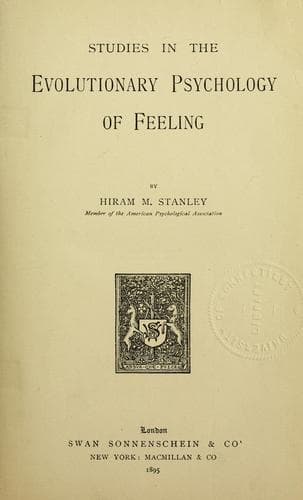
Studies in the Evolutionary Psychology of FeelingStanley, Hiram Miner
Philosophy
Studies in the Evolutionary Psychology of Feeling
Stanley, Hiram Miner
Emotions
factors which are closely knit into a single state which to common
observation seems simple, but which is really constituted in its
_ensemble_ by the total specific forces of many elements. In psychics,
as in physics, we know that common sense analysis of phenomena must be
at fault, and that one who says “I certainly have an entirely different
pain when I fear and when I despair,” is as much in the wrong as he who
maintains essential diversities in material substance, or radical
distinctions of species in the organic world. So we must believe that
the peculiar quality of the pain in despair exists, not in the pain
itself, but is really the colouring result from various coincident
sensations and ideas. The lowering of the mental tone far below the zero
point is greatly accentuated by refluent waves of organic sensation set
up from the physical basis of the psychic disturbance.
How, we may now ask, did despair ever evolve and become a well-defined
psychic form? in what way in the course of natural selection could such
an apparently disadvantageous variation have arisen and been developed?
The serviceability of fear is plain to every one, but of what possible
value could despair be in the struggle of life? The one who gives up in
despair is but very rarely doing the best thing. If we cannot look to
the general principle of evolution, serviceability, how can we account
for the appearance and growth of such a phase as despair, except as
abnormal variation, a disease, profitable to the enemies of the
individual, and so developed by and for external organisms. As there is
an abnormal pathological variation of fear, which we have previously
noticed, and which is forced in its development by enemies who profit by
it, so despair is a psychic disease, entirely hurtful to the individual,
and, so far, only advantageous for its enemies. Despair is, without
doubt, one of those altruistic variations which serve, not the
individual, but some antagonist in the struggle of existence. To bring
one to despair is to make him entirely helpless and wholly at our mercy
for our own ends. The possibility that active-reflective natures may
prey upon themselves is thus stimulated into an actual phenomenon whose
growth is continually fostered by those whose advantage it is to reduce
the individual to a helpless condition. Despair is hardly an hypertrophy
or atrophy of any normal tendency, it is rather a pathological _genus_
by itself. The capacity for despair being inherent in the general
formation of mind as subject to collapse, it arose solely in response to
the needs of organisms warring upon the organism afflicted. The whole
field of physical and psychical altruistic variation under the general
law of natural selection, decadent and self-injurious characteristics
being stimulated and maintained in a kind of artificial selection, is an
interesting but unexplored field, attention so far having been turned to
Public-domain text, read in full here on John Shaqi.
Reviews
Reviews
No reviews yet
Be the first to share your thoughts on this work.
Elsewhere in the archive
Join the Discussion
Join the discussion
Sign in to leave a comment or review.
Sign InorCreate an account