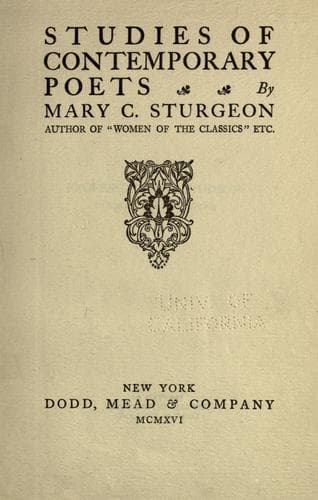
English poetry -- 20th century -- History and criticism
Marvellous dream!
Cupid has offered his arrows for Jesus to try;
He has offered his bow for the game.
But Jesus went weeping away, and left him there
wondering why.
That may be taken as Mr Monro's most representative poem. On our theory,
therefore (of this work as a link with the older school), the piece
might serve to indicate the point which contemporary poetry has reached,
advancing in technique and in thought straight from the previous
generation. Not that it is the most 'advanced' piece (in the specific
sense of the word) which one could cite from modern poets. Many and
strange have been the theories evolved on independent lines, just as
numerous weird technical effects have been gained by breaking altogether
with the tradition of native prosody. But Mr Monro's poetry continues
the tradition; and whether it be in content or in form, it has pushed
forward, in the normal manner of healthy growth, from the stage
immediately preceding.
The new technical features are clear enough, and all owe their origin to
a determination to gain the greatest possible freedom within the laws of
English versification. Rhyme is no longer a merely decorative figure,
gorgeous but tyrannical. It is an instrument of potential range and
power, to be used with restraint by an austere artist. In "Children of
Love" it occurs just often enough to convey the gentle sadness of the
emotional atmosphere. But very beautiful effects are gained without it,
as, for instance, in another of these later poems, called "Great
City"--
When I returned at sunset,
The serving-maid was singing softly
Under the dark stairs, and in the house
Twilight had entered like a moonray.
Time was so dead I could not understand
The meaning of midday or of midnight,
But like falling waters, falling, hissing, falling,
Silence seemed an everlasting sound.
The verse is not now commonly marked by an exact number of syllables or
feet, nor the stanza divided into a regular number of verses, except
where the subject requires precision of effect. An order of recurrence
does exist, however, giving the definite form essential to poetry. But
it is determined by factors which make for greater naturalness and
flexibility than the hard-and-fast division into ten-or eight-foot lines
and stanzas of a precise pattern. The ruling influences now are
various--the thought which is to be expressed, and the phases through
which it passes: the nature and strength of the emotion, the ebb and
flow of the poetic impulse.
Public-domain text, read in full here on John Shaqi.
Reviews
Reviews
No reviews yet
Be the first to share your thoughts on this work.
Elsewhere in the archive
Join the Discussion
Join the discussion
Sign in to leave a comment or review.
Sign InorCreate an account