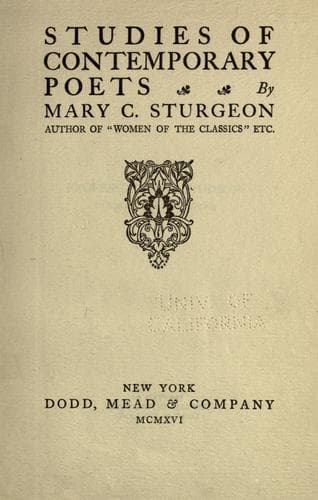
English poetry -- 20th century -- History and criticism
But in his more representative work, the intellectual realism which
comes from an acute sense of fact is clearly operative. We have seen,
too, from the earliest published verse of this poet, the continual
struggle of what one may call a religion of reality--belief in the
sanctity and beauty and value of the real world--for spiritual mastery.
In the later poems the two elements become deepened and are more closely
combined: they are, too, seeking expression through a technique which is
directed to the same realistic purpose. And as a result we get such a
piece of quiet fidelity as "London Interior"; or a tragedy like
"Carrion," in which the logic of life and death, controlling emotion
with beautiful gravity, is suddenly broken by a sob. It is the last of
four war-poems; a series representing the call of battle to the
soldier, his departure, a fighting retreat, and finally, in "Carrion,"
his death--
It is plain now what you are. Your head has dropped
Into a furrow. And the lovely curve
Of your strong leg has wasted and is propped
Against a ridge of the ploughed land's watery swerve.
.....
You are fuel for a coming spring if they leave you here;
The crop that will rise from your bones is healthy bread.
You died--we know you--without a word of fear,
And as they loved you living I love you dead.
No girl would kiss you. But then
No girls would ever kiss the earth
In the manner they hug the lips of men:
You are not known to them in this, your second birth.
.....
Hush, I hear the guns. Are you still asleep?
Surely I saw you a little heave to reply.
I can hardly think you will not turn over and creep
Along the furrows trenchward as if to die.
_Sarojini Naidu_
Mrs Naidu is one of the two Indian poets who within the last few years
have produced remarkable English poetry. The second of the two is, of
course, Rabindranath Tagore, whose work has come to us a little later,
who has published more, and whose recent visit to this country has
brought him more closely under the public eye. Mrs Naidu is not so well
known; but she deserves to be, for although the bulk of her work is not
so large, its quality, so far as it can be compared with that of her
compatriot, will easily bear the test. It is, however, so different in
kind, and reveals a genius so contrasting, that one is piqued by an
apparent problem. How is it that two children of what we are pleased to
call the changeless East, under conditions nearly identical, should have
produced results which are so different?
Public-domain text, read in full here on John Shaqi.
Reviews
Reviews
No reviews yet
Be the first to share your thoughts on this work.
Elsewhere in the archive
Join the Discussion
Join the discussion
Sign in to leave a comment or review.
Sign InorCreate an account