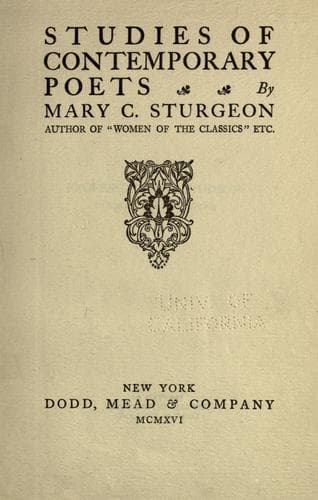
English poetry -- 20th century -- History and criticism
We hear, too, of a love-story that would make an idyll; of passion so
strong and a will so resolute as almost to be incredible in such a
delicate creature; of a marriage in defiance of caste, a few years of
brilliant happiness and then a tragedy. And all through, as a dark
background to the adventurous romance of her life, there is the shadow
of weakness and ill-health. That shadow creeps into her poems,
impressively, now and then. Indeed, if it were lacking, the bright
oriental colouring would be almost too vivid. So, apart from its
psychological and human interest, we may be thankful for such a poem as
"To the God of Pain." It softens and deepens the final impression of the
work.
For thy dark altars, balm nor milk nor rice,
But mine own soul thou'st ta'en for sacrifice.
The poem is purely subjective, of course, as is the still more moving
piece, "The Poet to Death," in the same volume.
Tarry a while, till I am satisfied
Of love and grief, of earth and altering sky;
Till all my human hungers are fulfilled,
O Death, I cannot die!
We know that that is a cry out of actual and repeated experience; and
from that point of view alone it has poignant interest. But what are we
to say about the spirit of it--the philosophy which is implicit in it?
Here is an added value of a higher kind, evidence of a mind which has
taken its own stand upon reality, and which has no easy consolations
when confronting the facts of existence. For this mind, neither the
religions of East nor West are allowed to veil the truth; neither the
hope of Nirvana nor the promise of Paradise may drug her sense of the
value of life nor darken her perception of the beauty of phenomena.
Resignation and renunciation are alike impossible to this ardent being
who loves the earth so passionately; but the 'sternly scientific'
nature of that early training--the description is her own--has made
futile regret impossible, too. She has entered into full possession of
the thought of our time; and strongly individual as she is, she has
evolved for herself, to use her own words, a "subtle philosophy of
living from moment to moment." That is no shallow epicureanism, however,
for as she sings in a poem contrasting our changeful life with the
immutable peace of the Buddha on his lotus-throne--
Nought shall conquer or control
The heavenward hunger of our soul.
It is as though, realizing that the present is the only moment of which
we are certain, she had determined to crowd that moment to the utmost
limit of living.
Public-domain text, read in full here on John Shaqi.
Reviews
Reviews
No reviews yet
Be the first to share your thoughts on this work.
Elsewhere in the archive
Join the Discussion
Join the discussion
Sign in to leave a comment or review.
Sign InorCreate an account