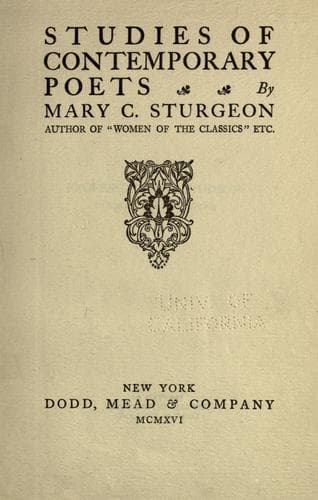
English poetry -- 20th century -- History and criticism
But that is dramatically appropriate--the logic of Joan's character. And
it seems to me that a more intimate and sincere expression is to be
found in the chastened mood of a sonnet called "To April":
There will be other days as fair as these
Which I shall never see; for other eyes
The lyric loveliness of cherry trees
Shall bloom milk-white against the windy skies
And I not praise them; where upon the stream
The faëry tracery of willows lies
I shall not see the sunlight's flying gleam,
Nor watch the swallows sudden dip and rise.
Most mutable the forms of beauty are,
Yet Beauty most eternal and unchanged,
Perfect for us, and for posterity
Still perfect; yearly is the pageant ranged.
And dare we wish that our poor dust should mar
The wonder of such immortality?
The wistfulness of that wins by its grace where a more strenuous
optimism provokes a challenge; just as the tentative 'perhaps' in the
last line of "Sophocles' Antigone" softly woos the sceptic:
There are fair flowers that never came to fruit;
Cut by sharp winds, or eaten by late frost,
Barrenly in forgetfulness, they're lost
To little-heedful Nature; so, in suit,
Beneath the footsteps of calamity
Young lives and lovely innocently come
To total up old evil's deadly sum--
Do the gods pity dead Antigone?
We look too close, we look too close on earth
At good and evil; blind are Nature's laws
That kill, or make alive, and so are done.
Not in the circle of this death and birth
May we perceive a justifying cause,
Beyond, perhaps, for God and good are one.
One must not pause to gather up the threads of personality in these
three volumes of lyrics; and, with the more important work in drama
still ahead, it is only possible just to glance at their specific
values. All the pieces are not equally good, of course, but there is a
proportion of exquisite poetry in each volume, and--a healthy sign--the
proportion is greatest in the last of the three, _Songs of Changing
Skies_, published in 1913. Of this best work there are at least three
kinds. There is that which one may call the lyric proper, small in size,
simple in design, light in texture, the free expression of a single
mood. Such is "From a Window," in which the peculiar charm of the poet's
verse in this kind is well seen. It is not a showy attractiveness: it
does not storm the senses nor clamour for approval. It enters the mind
quietly, and perhaps with some hesitancy; but having entered, it takes
absolute possession.
Public-domain text, read in full here on John Shaqi.
Reviews
Reviews
No reviews yet
Be the first to share your thoughts on this work.
Elsewhere in the archive
Join the Discussion
Join the discussion
Sign in to leave a comment or review.
Sign InorCreate an account