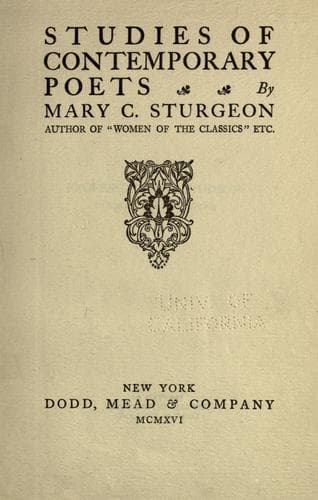
English poetry -- 20th century -- History and criticism
I shall not see it.
I shall be blind beneath my coffin lid
There in a foreign land; I shall not see
The glory and the splendour of St. Mark's
When our Italian flag salutes the sun;
I shall be deaf, and never hear the peal
Of our triumphant bells, and volleying guns;
I shall be dumb, I shall be dumb that day,
And never say "My people, for this hour
I saved you when I sacrificed you most."
The second passage burns with the fire of triumph, tragical but
prophetic, which has been kindled in Manin by his struggle with the
opposing will of the people and his victory over it:
Of this one thing be sure. A little time,
A little hour, in the span of years
That history devours, we submit
To bow before the flail of tyranny;
Ay, it may strike us down, and we may die
With Europe passive round our Calvary;
Yet that for which we stand, for liberty,
For equal justice, and the right of laws
Purely administered, can never die,
Being of the nature of eternity;
Nor all the blood that Austria has shed
Mar the indelibility of truth;
Nor all the graves that Austria has dug
Bury it deep enough; nor all the lies
That coward hearts have bandied to and fro,
And coward hearts received to trick themselves,
Smother the face of it.
There remains to be particularly noted the poet's gift of realizing
character. It is seen at its best in _Mary Queen of Scots_, where the
unfortunate Queen is very strikingly recreated. Out of the diverse and
stormy elements of her nature she is made to live again with a clear
unity and completeness which are amazing. That is largely the reason why
this play is the most powerful of the five, from the point of view of
pure drama. Its theme is unerringly chosen, for drama inheres in Mary's
being. The seeds of tragedy lurk in her contrasted weakness and
strength, excess and defect, nobility and baseness. And, because she has
been so brilliantly studied, this play moves at every step to the
majestic truth that character is destiny.
The broad lines of Mary's personality are established in the first act,
revealing at once the springs of action. The sensuous basis of her
nature, her strong will and quick temper, may be seen to set in motion
the forces which will presently overwhelm her. Her widowed state is
irksome--therefore she will marry. She hates authority--therefore she
will make her own choice in the matter of a husband. And finer threads
already begin to complicate the issues. She is really fond of Darnley,
the weak youth whom she is determined to marry; but that motive is
intricately mixed with the satisfaction of insulting Elizabeth through
him; while her ready wit gives a spice to her malice which, in dialogue
at least, is very refreshing. When she enters the audience-chamber she
calls Darnley to her side and, with a gesture towards the gloomy faces
of the disaffected nobles, says in merry mockery:
Public-domain text, read in full here on John Shaqi.
Reviews
Reviews
No reviews yet
Be the first to share your thoughts on this work.
Elsewhere in the archive
Join the Discussion
Join the discussion
Sign in to leave a comment or review.
Sign InorCreate an account