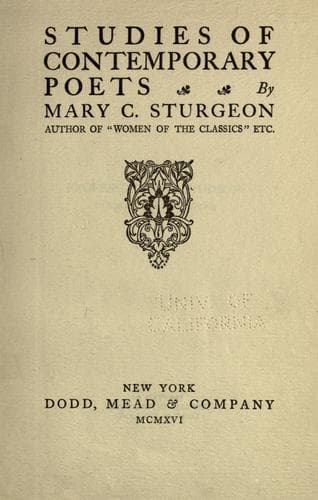
English poetry -- 20th century -- History and criticism
Then, reminiscent of the dear friendliness of those banished human
souls, desolation comes upon the solitary Being. He remembers that he is
eternal and ringed round with Infinity. He sends thought flying back
through endless centuries, but cannot find the beginning of Time. He
ranges North and South, but cannot find the bounds of Space. He is most
utterly alone--save for his silly singing angels--in the monotonous
glory of his heaven.
... Many days I sped
Hard to the west, a thousand years I fled
Eastwards in fury, but I could not find
The fringes of the Infinite....
--till at last
Dizzied with distance, thrilling to a pain
Unnameable, I turned to Heaven again.
And there My angels were prepared to fling
The cloudy incense, there prepared to sing
My praise and glory--O, in fury I
Then roared them senseless, then threw down the sky
And stamped upon it, buffeted a star
With My great fist, and flung the sun afar:
Shouted My anger till the mighty sound
Rung to the width, frighting the furthest bound
And scope of hearing: tumult vaster still,
Thronging the echo, dinned my ears, until
I fled in silence, seeking out a place
To hide Me from the very thought of Space.
There was once a reviewer who compared the genius of this poet to that
of Homer and Æschylus. Now comparisons like that are apt to tease the
mind of the discriminating, to whom there instantly appear all the gulfs
of difference. But, indeed, this poet does share in some measure, with
Æschylus and our own Milton and the unknown author of the Book of Job, a
sublimity of vision. His conceptions have a grandeur of simplicity; and
he makes us realize immensities--Eternity and Space and Force--by images
which are almost primitive. Like those other poets too, whose
philosophical conceptions were as different from his as their ages are
remote, he also has made God in the image of man. But the comparison
does not touch what we may call the human side of this newer genius;
and it only serves to throw into bolder relief its perception of life's
comedy, its waywardness, and its mischievous humour. This aspect,
strongly contrasted as it is with the poet's imaginative power, is at
least equally interesting. It is apparent, in the earlier work, in the
realism of such pieces as "The Dancer" or "The Street." There is a touch
of harshness in these poems which would amount to crudity if their
realism were an outward thing only. But it is not a mere trick of style:
it proceeds from indignation, from an outraged æsthetic sense, and from
a mental courage which attains its height, rash but splendid, in
"Optimist"--
Let ye be still, ye tortured ones, nor strive
Where striving's futile. Ye can ne'er attain
To lay your burdens down.
Public-domain text, read in full here on John Shaqi.
Reviews
Reviews
No reviews yet
Be the first to share your thoughts on this work.
Elsewhere in the archive
Join the Discussion
Join the discussion
Sign in to leave a comment or review.
Sign InorCreate an account