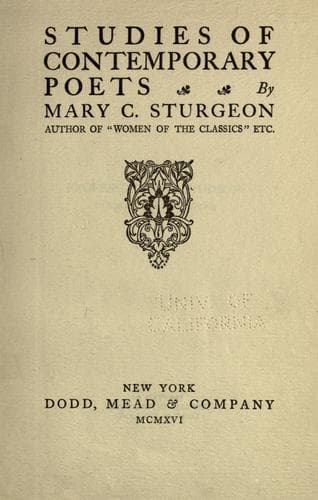
English poetry -- 20th century -- History and criticism
It will be seen that the lyric gift of the poet moves at the prompting
of an imaginative passion. It is nearly always so in this poetry. Very
seldom does the impulse appear to come from intimate personal emotion or
individual experience; and the volume may therefore help to refute the
dogma that the poetry of a woman is bound to be subjective, from the
laws of her own nature. Occasionally, of course, a direct cry will seem
to make itself heard--the most reticent human creature will pay so much
toll to its humanity. And it is true that in such a spontaneous
utterance the voice will be distinctively feminine--life as the woman
knows it will find its interpreter. Thus we see austerity breaking down
in the poem "On the Death of an Infant," mournfully sweet with a
mother's sorrow. Hence, too, in "Under the Lamp" comes the loathing for
"the vile hidden commerce of the city"; and equally there comes a touch
of that feminine bias (yielding in these late days perhaps to fuller
knowledge and consequent sympathy) which inclines to regard the evil
from the point of view of the degradation of the man rather than that of
the hideous wrong to the woman. Or again, there is "The Changeling,"
perhaps the tenderest of the few poems which may perhaps, in some sense,
be called subjective. Through the thin veil of allegory one catches a
glimpse of the enduring mystery of maternal love. The mother is brooding
over the change in her child: she has not been watchful enough, she
thinks; and while she was unheeding, some evil thing had entered into
her baby and driven out the fair soul with which he began.
Perhaps he called me and I was dumb.
Unconcerned I sat and heard
Little things,
Ivy tendrils, a bird's wings,
A frightened bird--
Or faint hands at the window-pane?
And now he will never come again,
The little soul. He is quite lost.
She tries to woo him back, with prayer and incantations; but he will not
come; and when at last she is worn out with waiting, she seeks an old
wizard and begs him to give her forgetfulness. But it is a hard thing
that she is asking: it needs a mighty spell to make a woman forget her
son; and the mother has to go without the boon. She has not wealth
enough in the world to pay the Wise Man's fee. But afterwards she is
glad that she was too poor to pay the price:
Because if I did not remember him,
My little child--Ah! what should we have,
He and I? Not even a grave
With a name of his own by the river's brim.
Because if among the poppies gay
On the hill-side, now my eyes are dim,
I could not fancy a child at play,
And if I should pass by the pool in the quarry
And never see him, a darling ghost,
Sailing a boat there, I should be sorry--
If in the firelit, lone December
I never heard him come scampering post
Haste down the stair--if the soul that is lost
Came back, and I did not remember.
Public-domain text, read in full here on John Shaqi.
Reviews
Reviews
No reviews yet
Be the first to share your thoughts on this work.
Elsewhere in the archive
Join the Discussion
Join the discussion
Sign in to leave a comment or review.
Sign InorCreate an account