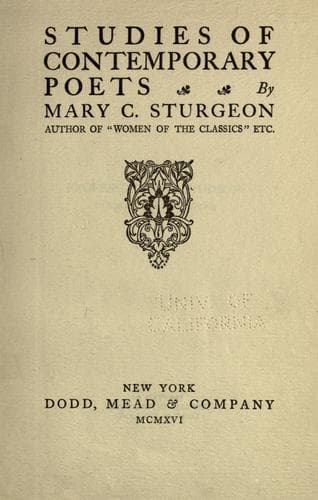
English poetry -- 20th century -- History and criticism
This poem is characteristic, both in the way it blends imagination and
profound feeling with pensive thought, and in its literary flavour. One
may note the opulent language, enriched from older sources, the
historical lore and the allusive touch so fascinating to those who love
literature for its own sake. But the poet can work at times in a very
different manner. There is, for instance, another piece of unrhymed
verse, "March Thoughts From England," which is a riot of light and
colour, rich scent and lovely shape and bewitching sound--the sensuous
rapture evoked by a Provençal scene 'recollected in tranquillity.' Or
there is "April," with the keen joy of an English spring, also a glad
response to the direct impressions of sense. Imagination is subordinated
here; but if we turn in another direction we are likely to find it
paramount. It may be manifested in such various degrees and through such
different media that sharp contrasts will present themselves. Thus we
might turn at once from the playful fancy of "The Child Alone" (where a
little maid has escaped from mother and nurse into the wonderful,
enchanted, adventurous world just outside the garden) to the
thrice-heated fire of "Again I Saw Another Angel." Here imagination has
fanned thought to its own fierce heat; and in the sudden flame serenity
is shrivelled up and gives place to passionate despair. In a vision the
poet sees the awful messenger of the Lord leap into the heavens with a
great cry--
Then suddenly the earth was white
With faces turned towards his light.
The nations' pale expectancy
Sobbed far beneath him like the sea,
But men exulted in their dread,
And drunken with an awful glee
Beat at the portals of the dead.
I saw this monstrous grave the earth
Shake with a spasm as though of birth,
And shudder with a sullen sound,
As though the dead stirred in the ground.
And that great angel girt with flame
Cried till the heavens were rent around,
"Come forth ye dead!"--Yet no man came.
But from the intensity of that we may pass to the dainty grace of the
Songs, where the poet is weaving in a gossamer texture. Or we may
consider a love-lyric like "Passing," a fragile thing, lightly evoked
out of a touch of fantasy and a breath of sweet pain.
With thoughts too lovely to be true,
With thousand, thousand dreams I strew
The path that you must come. And you
Will find but dew.
I break my heart here, love, to dower
With all its inmost sweet your bower.
What scent will greet you in an hour?
The gorse in flower.
Public-domain text, read in full here on John Shaqi.
Reviews
Reviews
No reviews yet
Be the first to share your thoughts on this work.
Elsewhere in the archive
Join the Discussion
Join the discussion
Sign in to leave a comment or review.
Sign InorCreate an account