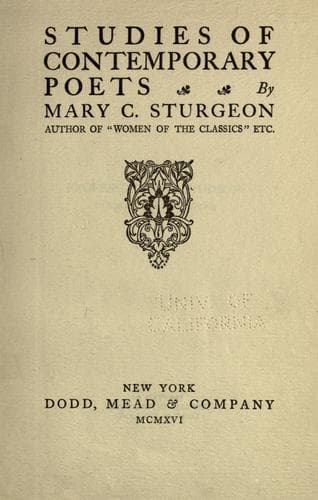
English poetry -- 20th century -- History and criticism
That poem naturally comes first in a little study, because it is the
most considerable in the collection, and again because it is the most
characteristic. It is very convenient, too, for illustrating those
theories of the preface, as for example, that the business of the poet
is "the right appreciation of such facets of our own day as God will let
us perceive ... the putting of certain realities in certain aspects ...
the juxtaposition of varied and contrasting things ... the genuine love
and the faithful rendering of the received impression." But on æsthetic
grounds one is not so sure of "To All the Dead" for the first place.
Perhaps it tries to include too many facets of life--or death; perhaps
we get a slight impression as regards technique that the poet is
_consciously_ experimenting; and there is a shade of morbidity haunting
it. In many of the shorter pieces there is a nearer approach to
perfection. "The Portrait," for instance, a symbolical picture of life,
has only one flaw; a slight excess of a trick of repetition which is a
weakness of our author. It is mere carping, however, to find fault with
a piece which is so noble in idea and gracious in expression; and it
seems a crime to spoil the lovely thing by mutilating it. But with a
resemblance of theme, the poem is so strongly contrasted in manner with
"To All the Dead" that one cannot resist quoting from it at this point.
The idea, although great, is relatively simple: life, symbolized in the
figure of a woman, seated upon a tomb in a sequestered graveyard. The
mood is one of serene melancholy, not rising to passion or dropping to
satire; and the gentle unity of thought and feeling leaves the mind free
to receive the impression of beauty.
She sits upon a tombstone in the shade;
.....
Being life amid piled up remembrances
Of the tranquil dead.
... So she sits and waits.
And she rejoices us who pass her by,
And she rejoices those who here lie still,
And she makes glad the little wandering airs,
And doth make glad the shaken beams of light
That fall upon her forehead: all the world
Moves round her, sitting on forgotten tombs
And lighting in to-morrow.
Public-domain text, read in full here on John Shaqi.
Reviews
Reviews
No reviews yet
Be the first to share your thoughts on this work.
Join the Discussion
Join the discussion
Sign in to leave a comment or review.
Sign InorCreate an account