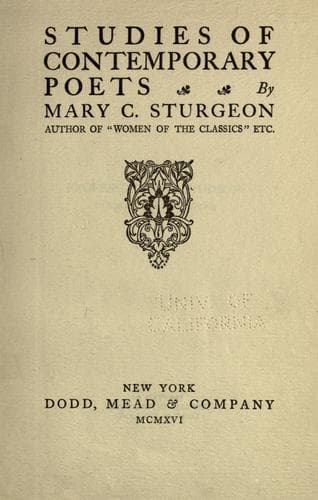
English poetry -- 20th century -- History and criticism
That was written earlier than "To All the Dead," but, like the two songs
which come immediately after it in this volume, and like the "Suabian
Legend," it is amongst Mr Hueffer's best things. One precious quality is
the temperament which pervades it--and the principal artistic
significance of all this work is to have expressed so strikingly an
exuberant and complex personality. Sensibility rules, perhaps; but
reflective power is visibly present, with a vein of irony running below
it, precipitated out of its own particular share of the bitterness that
nobody escapes. In one aspect after another this individuality is
revealed, and the changing moods are matched by changing forms. It
follows that there are many varied measures here; and most of them have
some new feature. A few are very irregular, and all are, of course,
modelled to suit the author's impressionistic theory. And the fact that
these forms are in the main so well adapted to their themes: that they
are so successful in conveying the desired impression, is as much as to
say that the poet has evolved a technique which perfectly suits his own
genius. It may or it may not carry much further than that; and the
extent to which the new instrument would respond to other hands may be
problematical. One would suppose that some of its qualities at least
would be a permanent gain, particularly the larger range which brings
within its compass so many fresh aspects of life on the one hand and on
the other a richer idiom. But whether or no these are qualities which
will pass into the substance of future poetry, there can be no question
that life seen through this particular temperament is interpreted
vividly by this method.
Thus we have the fulmination of "Süssmund's Address to an Unknown God";
violent, bitter, and unreasoned, the mere rage of weary mind and body
against the goads of modern existence. Thus, in the "Canzone _à la_
Sonata" as in "The Portrait" a single serious thought is rendered in
grave unrhymed stanzas which have all the dignity of blank verse with
something more than its usual vivacity; and thus, too, in "From Inland,"
one of the exquisite pieces of the volume, the whole of a tragedy is
suggested by the rapid sketching of two or three brief scenes. Again the
verse is perfectly fitted to the theme; the sober rhythm matching the
quietness of retrospect; memory tenderly grieving in simple rhymes which
vary their occurrence as emotion rises and falls.
"... We two," I said,
"Have still the best to come." But you
Bowed down your brooding, silent head,
Patient and sad and still....
Public-domain text, read in full here on John Shaqi.
Reviews
Reviews
No reviews yet
Be the first to share your thoughts on this work.
Join the Discussion
Join the discussion
Sign in to leave a comment or review.
Sign InorCreate an account