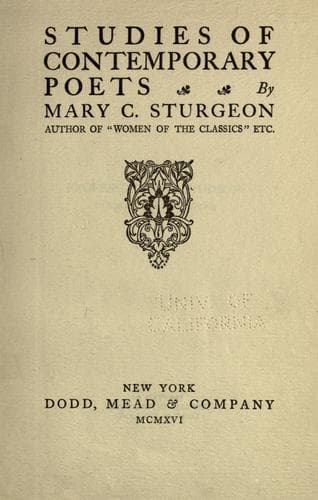
English poetry -- 20th century -- History and criticism
Doubtless we owe this air of newness largely to the rebirth of
literature in the Isle. When we say that poetry has never slumbered
there, we get as near to the truth as is possible; it seems always to
have been quick, eager and spontaneous, and never to have drowsed or
faded. But there was a black age when it was smitten so hard by external
misfortune that it nearly died. It was early in the nineteenth century
when, as Dr Hyde tells, "The old literary life of Ireland may be said to
come to a close amidst the horrors of famine, fever and emigration." All
that Dr Hyde and Lady Gregory have done to build up the new literary
life of their land cannot be fully realized yet. But out of their
labours has surely sprung the movement which we call the Irish Literary
Renaissance--a movement in which, disregarding cross currents, the
detached observer would include the whole revival, whether popular or
æsthetic. By fostering the Gaelic they have awakened in the people
themselves a sense of the dignity of their own language and literature.
By the translation of saga and romance, the patient gathering of
folk-tale and fairy-lore, the search for and interpretation of old
manuscripts, they have given to native poets a mass of material which is
peculiarly suited to their genius. And since approximately the year 1890
they have seen their reward in the work of a band of brilliant writers.
Romance is reborn in the novel; the poetry of the old saga blooms again
in the lyric; and a healthy new development has given to Ireland what
she never before possessed--a native drama.
Now it is true that the larger figures of the movement have receded a
little; the one in whom the flame of genius burned most fiercely has
passed into silence. And Synge being gone, there is no hand like his,
cunning to modulate upon every string of the harp. There is no voice of
so full a compass, booming out of tragic depths or shrilling satiric
laughter or sweet with heroic romance; breathing essential poetry and
yet rich with the comedy of life. It is a fact to make us grieve the
more for that untimely end, but it is not a cause for despair. For there
are many legatees of the genius of Synge. They are slighter
figures--naturally so, at this stage of their career--but they belong,
as he did, to the new birth of the nation's genius and they draw their
inspiration directly from their own land.
Public-domain text, read in full here on John Shaqi.
Reviews
Reviews
No reviews yet
Be the first to share your thoughts on this work.
Elsewhere in the archive
Join the Discussion
Join the discussion
Sign in to leave a comment or review.
Sign InorCreate an account