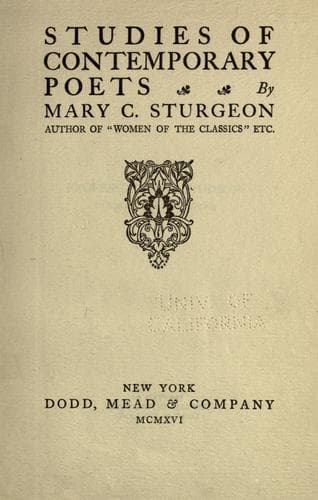
English poetry -- 20th century -- History and criticism
Here we touch a constant feature of Irish poetry. Dr. Hyde tells that
from the earliest times the bards were imbued with the spirit of
nationality: that their themes were always of native gods and heroes,
and that they were, in a sense, the guardians of national existence. The
singers of a later day curiously resemble them in this. Sometimes it is
a matter of outward likeness only, the new poets having drawn directly
upon the stories which have been placed in their hands from the old
saga. But much more often it is a rooted affinity--a thing of blood and
nerve and mental fibre. Then, although the gods may bear another name
and the heroes be of a newer breed and the national ideal may be
enlarged, it is still with these things that the poets are preoccupied.
This has become to the scoffer a matter of jest, and to the grumbler a
cause of complaint--that the Irish poet is obsessed by race. They say
that they can guess beforehand what will be the mood, the manner and the
subject of nine Irish poems out of ten. They are very clever people, so
they probably could get somewhere near the mark. And they would
naturally find themselves cramped in these narrow bounds. Religion and
history and national ideals would give them no scope. But when they
maintain that this is a radical defect, I am not at all convinced. I
remember that many of the world's great books proceeded from an intense
national self-consciousness; and I ask myself whether it may not be a
law in the literary evolution of a people, as well as in their political
development, that they proceed by way of a strong, free and proud spirit
of nationality to something wider. The reply may be that that is a
relatively early stage through which, in a normal literary progress,
Ireland should have passed long since. True, but normal growth and
advance have never been possible to her; and recalling the events of her
history, it is something of a marvel that the literary genius should
have survived at all.
In contrast with modern English poetry, impatient as it is to escape
from tradition, these traits which mark a line of descent so clearly are
the more striking. One may even smile a little at them--whimsically, as
we do when we see a youth or a young girl reproducing the very looks and
tones and gestures of an older generation. There is something comical in
the unconscious exactitude of it. But the laugh comes out of the deeper
sources of comedy. There lies below it, subconsciously perhaps, a
profound sense of those things in life which are most precious and most
enduring.
Public-domain text, read in full here on John Shaqi.
Reviews
Reviews
No reviews yet
Be the first to share your thoughts on this work.
Elsewhere in the archive
Join the Discussion
Join the discussion
Sign in to leave a comment or review.
Sign InorCreate an account