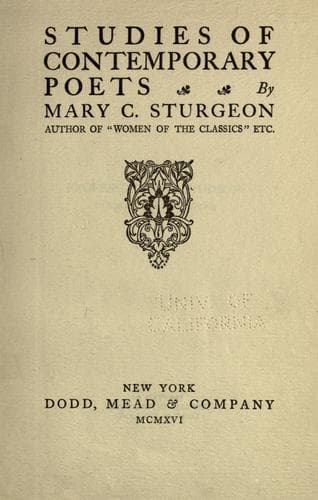
English poetry -- 20th century -- History and criticism
Again it is possible (though hardly probable one would think) that Mr
George Moore does not really enjoy the fun so cleverly poked at him in
the stanzas, "George Moore Comes to Ireland." Safe in our own
detachment, the criticism seems delicious, brightly hitting off the
personality which has grown so familiar in Mr Moore's work, and
especially in "Hail and Farewell": the delightful garrulity, the
disconcerting candour, the intimacy and naïve egoism, and the perfectly
transparent what-a-terror-I-was-in-my-youth air. The speaker in the poem
is, of course, Mr Moore himself; and it will be seen how cunningly the
author has caught his attitude, particularly to the work of Mr W. B.
Yeats--
I haven't tried potato cake or Irish stew as yet;
I've lived on eggs and bacon, and striven to forget
A naughty past of ortolan and frothy omelette.
.....
But W. B. was the boy for me--he of the dim, wan clothes;
And--don't let on I said it--not above a bit of pose;
And they call his writing literature, as everybody knows.
If you like a stir, or want a stage, or would admirèd be,
Prepare with care a naughty past, and then repent like me.
My past, alas! was blameless, but this the world won't see.
When Miss Mitchell's satire is engaged on personalities in this way, it
has a piquancy which may obscure the subtler flavour of it. But the
truth is that it is often literary in a double sense, both in subject
and in treatment. So we may find a theme of considerable general
interest in the world of literature, treated in the allusive literary
manner which has so much charm for the booklover. And to that is added a
racy and vigorous satirical touch. Thus, for instance, is the question
of Synge's _Playboy_ handled. Ridicule is thrown on the stupid rage with
which it was received, and on the folly which generalized so hotly from
the play to the nation, deducing wild nonsense against a whole people
and its literature because the man who killed his father in the story is
befriended by peasants. Here is a snatch of it:
I can't love Plato any more
Because a man called Sophocles,
Who lived in distant Attica,
Wrote a great drama _Oedipus_,
About a Greek who killed his da.
I know now Plato was a sham,
And Socrates I brush aside,
For Phidias I don't care a damn,
For every Greek's a parricide.
So, too, comes the burlesque touch in the "Ode to the British Empire":
God of the Irish Protestant,
Lord of our proud Ascendancy,
Soon there'll be none of us extant,
We want a few plain words with thee.
Thou know'st our hearts are always set
On what we get, on what we get.
Public-domain text, read in full here on John Shaqi.
Reviews
Reviews
No reviews yet
Be the first to share your thoughts on this work.
Elsewhere in the archive
Join the Discussion
Join the discussion
Sign in to leave a comment or review.
Sign InorCreate an account