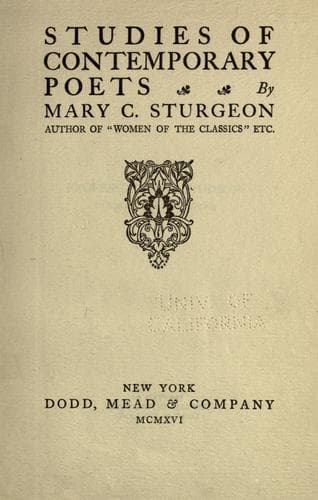
English poetry -- 20th century -- History and criticism
Laugh and be merry, remember, better the world with a song,
Better the world with a blow in the teeth of a wrong.
Laugh, for the time is brief, a thread the length of a span.
Laugh and be proud to belong to the old proud pageant of man.
Sometimes a minor key is struck, as in "Prayer;" but even here the joy
is present, revealing itself in sharp regret for the beloved things of
earth. It manifests itself in many ways, subtler or more obvious; but
mainly I think in a questing, venturous spirit which must always be
daring and seeking something beyond. Whether in the material world or
the spiritual, it is always the same--whether it be sea-longing, or
hunger for the City of God, or a vague faring to an unknown bourne, or
the eternal quest for beauty. The poem called "The Seekers" is
beautifully apt in this regard. Simply, clearly, directly, it expresses
the alpha and omega of this genius: the zest which is its driving force
and the aspiration, the tireless and ceaseless pursuit of an ideal,
which is its objective.
Not for us are content, and quiet, and peace of mind,
For we go seeking a city that we shall never find.
There is no solace on earth for us--for such as we--
Who search for a hidden city that we shall never see.
There is the spirit of adventure, the eternal allure of romance, as old
and as potent as poetry itself. And surely nothing is more engaging,
nothing quicker and stronger and more universal in its appeal, than zest
for life finding expression in this way. In these early lyrics its
spontaneous and simple utterance is very winning; but in the later
narrative poems it is none the less present because, having grown a
little older, it is a little more complex and not so obvious in its
manifestation. Under these longer poems too runs the stream of joy,
somewhat quieter now, perhaps, subdued by contemplation, brought to the
test of actuality, shaping a different form through the conflict of
human will, but still deep and strong, and, as in the earlier work,
expressing its ultimate meaning through the spirit of high adventure.
Public-domain text, read in full here on John Shaqi.
Reviews
Reviews
No reviews yet
Be the first to share your thoughts on this work.
Elsewhere in the archive
Join the Discussion
Join the discussion
Sign in to leave a comment or review.
Sign InorCreate an account