The abolition writers and speakers are properly divided into two
classes: those who agitate and advocate the subject as a successful
means of advancing their own personal and ambitious hopes; sometimes
with
“One eye turned to God, condemning moral evil;
The other downward, winking at the devil!”
Thus, one seeks office, another distinction or fame. Small
considerations often stimulate the conduct of such men.
But we have evidence that another class zealously labour to abolish
slavery from the world, because they think its existence a stain on the
human character, and that the laws of God make it the duty of every man
to “cry aloud and spare not,” until it shall cease.
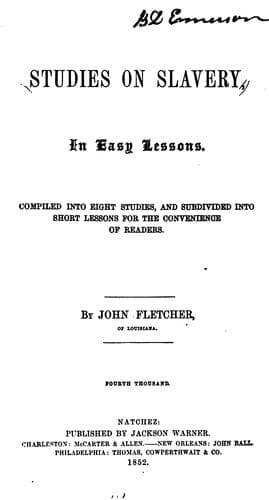
Our author had no secondary views alluring him on to toil; no new
purpose; no new summit to gain. What he thought darkness he hated,
because he loved the light; what he thought wicked, to his soul was
awful and abhorred, because, even in life, he was ever peering into the
confines of heaven. Ardour was cultivated into zeal, and zeal into
enthusiasm.
In its eagerness to accomplish its object in behalf of liberty, the mind
is often prepared to subvert without reflection—to destroy without care.
Hence, even the religious may sometimes “record that they have a zeal of
God, but not according to knowledge.” “For they being ignorant of God’s
righteousness, and going about to establish their own righteousness,
have not submitted themselves unto the righteousness of God.” _Rom._ x.
They are convinced that they alone are right. But, “Can a man be
profitable unto God, as he that is wise may be profitable unto himself?
_Is it_ any pleasure to the Almighty, that thou art righteous? or _is
it_ gain, that thou makest thy ways perfect.” _Job_ xxii. 2, 3.
“Knowest thou the ordinances of heaven? Canst thou set the dominion
thereof in the earth?” Answer thou, Why “leaveth the ostrich her eggs in
the earth, and warmeth them in the dust? Why forgetteth she that the
foot may crush them, or that the wild beast may break them?”
“Why is she hardened against her young ones, as though they were not
hers?” “Why is her labour in vain without fear?”
“Why feedeth the fish upon its fellow, which forgetteth and devoureth
its young?”
“Who looketh on the proud and bringeth him low? and treadeth down the
wicked in their place? hiding them in the dust, and binding their faces
in secret?”
Who hardeneth the heart of Pharaoh? and multiplies signs and wonders
before the children of men? Who is he who “hath mercy on whom he will?”
Why was Esau hated or Jacob loved before they were born?
Wilt thou say, “Why doth he find fault? for who hath resisted his will.”
See _Rom._ ix. 19.
Or wilt thou rather say, “Behold I am vile; what shall I answer thee? I
will lay my hand upon my mouth. Once have I spoken; but I will not
answer thee: yea, twice; but I will proceed no further.” _Job_ xl. 4.
* * * * *
Public-domain text, read in full here on John Shaqi.
Reviews
Reviews
No reviews yet
Be the first to share your thoughts on this work.
Elsewhere in the archive
Join the Discussion
Join the discussion
Sign in to leave a comment or review.
Sign InorCreate an account