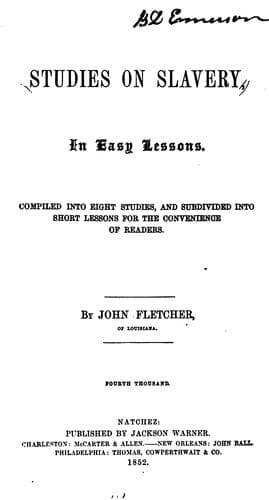
When the relation of things is not thus obvious, that is, when the
proposition involves the _determination_ of the relation between two or
more things whose relations are not intuitively perceived, the mind may
sometimes come to a certainty, concerning the relation, by the
interposition of a chain of axioms; that is, of propositions where the
relations are intuitively perceived. This is called demonstration.
In all such cases, the mind would perceive the relation, and come to a
certainty intuitively, if adequately cultivated and enlarged; or, in
other words, all propositions that now, to us, require demonstration,
would, to such a cultivation, become mere axioms: consequently, now,
where one man sees a mere axiom, another requires demonstration.
But the great mass of our ideas are too imperfect or too complicated to
admit of intuitive conclusions; consequently, as to them, we can never
arrive at demonstration. Here we substitute facts; and reason, that, as
heretofore one certain fact has accompanied another certain fact, so it
will be hereafter. This is what the philosophers call analogy. Analogy
is thus founded on experience, and is, therefore, far less perfect than
intuition or demonstration. That gravitation will always continue is
analogical; we do not know it intuitively; nor can we demonstrate it.
Analogical propositions are, therefore, to us mere probabilities.
But our knowledge has cognizance of ideas only. These ideas we
substitute for the things they represent, in which there is a liability
to err. Thus a compound idea is an assemblage of the properties of a
thing, and may be incomplete and inadequate; wholly different from any
quality in the thing itself. What is our idea of spirit, colour, joy?
Yet we may conceive an intelligence so extended as to admit that even
analogical problems should become intuitive: with God every thing is
intuitively known. But even intuitive propositions sometimes reach
beyond our comprehension. Example—a line of infinite length can have no
end: therefore, the half of an infinite line would be a line also of
infinite length. But all lines of infinite length are of equal length;
therefore, the half of an infinite line is equal to the whole. Such
fallacies prove that human reason is quite limited and liable to err:
and hence the importance of faith in God, in the steadfastness of his
laws, and the certainty of their operations. “And Jesus answering said
unto them, have faith in God.” _Mark_ xi. 22. “And when they were come,
and had gathered the church together, they rehearsed all that God had
done with them, and how he had opened the door of faith unto the
Gentiles.” _Acts_ xiv. 27. “So, then, faith cometh by hearing, and
hearing by the word of God.” _Romans_ x. 17. That is, by revelation.
“Now faith is the substance of things hoped for, the evidence of things
not seen.” _Heb._ xi. 1. “But without faith it is impossible to please
God; for he that cometh to God must believe that he is, and that he is
Public-domain text, read in full here on John Shaqi.
Reviews
Reviews
No reviews yet
Be the first to share your thoughts on this work.
Elsewhere in the archive
Join the Discussion
Join the discussion
Sign in to leave a comment or review.
Sign InorCreate an account