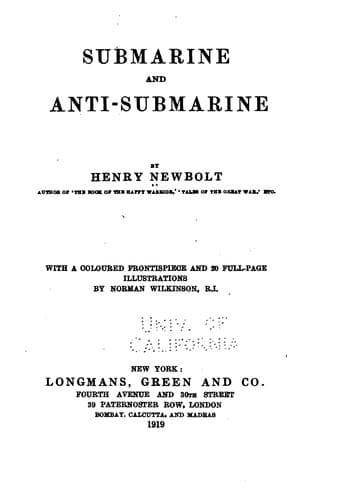
Submarine and Anti-submarineNewbolt, Henry John, Sir
History
Submarine and Anti-submarine
Newbolt, Henry John, Sir
Submarines (Ships); World War, 1914-1918 -- Naval operations -- Submarine
In 1917 and 1918, the ‘proudest’ and most ‘joyful’ period in the short
history of the German Navy, there was no longer any need for the
humiliation of excuses. On January 31, 1917, Germany proclaimed her
intention of sinking at sight every ship found in the waters around
the British Isles and the coast of France, or in the Mediterranean
Sea. It was at the same time announced--quite falsely--that the German
Government had conclusive proof of the misuse of hospital ships for
the transport of munitions and troops, and that therefore the traffic
of hospital ships within certain areas ‘would no longer be tolerated.’
President Wilson dealt promptly with this infamous proclamation. On
February 3, he told Congress that he had severed diplomatic relations
between America and Germany; on April 6, he formally declared war.
The savages were now entirely free to take their own way, and they
took it. On the night of March 20, 1917, the hospital ship _Asturias_,
steaming with all navigating lights, and with all the proper Red
Cross signs brilliantly illuminated, was torpedoed and sunk without
warning. Of the medical staff on board, 14 were lost, including one
nurse, and of the ship’s company 29, including one stewardess. On March
30, the _Gloucester Castle_ was torpedoed without warning, but her
wounded were all got off in safety. On April 17, the _Donegal_ and the
_Lanfranc_ were both sunk while bringing wounded to British ports. In
the _Donegal_, 29 wounded were lost, and 12 of the crew. The _Lanfranc_
carried, besides 234 British wounded and a medical staff of 52, a batch
of wounded German prisoners to the number of 167, including officers.
‘The moment the torpedo struck the _Lanfranc_,’ wrote a British officer
on board, ‘the Prussians made a mad rush for the life-boats. One of
their officers came up to a boat close to which I was standing. I
shouted to him to go back, whereupon he stood and scowled, “You must
save _us_.” I told him to wait his turn. Other Prussians showed their
cowardice by dropping on their knees and imploring pity. Some cried
“Kamarad,” as they do on the battle-field. I allowed none of them to
pass me.... In these moments, while wounded Tommies lay in their cots
unaided, the Prussian moral dropped to zero. Our cowardly prisoners
made another crazy effort to get into a life-boat. They managed to
crowd into one--it toppled over. The Prussians were thrown into the
water, and they fought with each other in order to reach another
boat containing a number of gravely wounded British soldiers.... The
behaviour of our own lads I shall never forget!’--but there is no
need to tell that part of the story; it is old, centuries old, and is
repeated unfailingly whenever a British ship goes down.
Public-domain text, read in full here on John Shaqi.
Reviews
Reviews
No reviews yet
Be the first to share your thoughts on this work.
Elsewhere in the archive
Join the Discussion
Join the discussion
Sign in to leave a comment or review.
Sign InorCreate an account