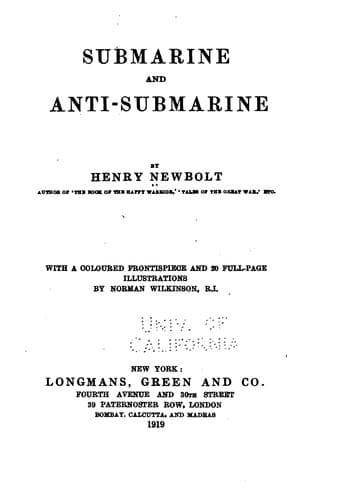
Submarine and Anti-submarineNewbolt, Henry John, Sir
History
Submarine and Anti-submarine
Newbolt, Henry John, Sir
Submarines (Ships); World War, 1914-1918 -- Naval operations -- Submarine
In reading the accounts which follow, it will be remarked that the
work to which our trawlers and drifters set themselves, with such
admirable readiness and courage, was not only new to them, but was
continually taking new and unforeseen forms, so that they have been
called upon to show quickness and adaptability, as well as the capacity
for training and discipline. The armament and methods of the submarine
of 1915 were different from those of the later and more dangerous
boats of 1917. The trawlers, too, were much less adequately armed and
equipped. Our men had at first to play a game in which there were no
certain rules, and no standard weapons. We can hardly over-praise the
officers of the R.N.R. who, in those critical days, took command of the
special-service trawlers and fought them with the native skill of the
Elizabethan sea-dogs. Nor can we admire too heartily the ready pluck
and patriotism with which the skippers, mates, deck-hands and boys of
our fishing-fleets turned their hands at a moment’s notice from nets to
depth-charges and twelve-pounders, and undertook the daily sweeping of
mines, in seas now doubly treacherous, and a hundred times more deadly.
There is a strange and almost pathetic sound, even in the names of the
little ships themselves--names bearing none of the splendour of history
or the prestige of war, but the humble and intimate memories of wives
and children, or the jesting pride of the homely seaport where they
lived in the time of peace.
The _Ina Williams_ (now His Majesty’s Trawler, _Ina Williams_) was
steaming towards the Irish coast at seven o’clock, one evening in early
summer, when she sighted a large submarine on her port beam, some
two-and-a-half miles away. The enemy had just come to the surface; for
there was no sign of him in that direction a few moments before, and
he had not yet got his masts or ventilators up. The _Ina Williams_
was armed, fortunately, with a 12-pounder gun, and commanded by
Sub-Lieutenant C. Nettleingham, R.N.R., who had already been commended
for good conduct, and after nine months’ hard work was not likely to
lose a fighting chance.
He headed straight for the U-boat. She might, of course, submerge
at any moment, leaving the pursuer helpless. But Mr. Nettleingham
calculated that she would disdain so small an enemy, and remain
upon the surface, relying upon her trained gunners and keeping her
superiority of speed, with her torpedoes in case of extreme necessity.
He was right in the main. The U-boat accepted battle by gunfire; but
a torpedo which missed the starboard quarter of the _Ina Williams_
by only 10 feet must have been fired at least as soon as the trawler
sighted her, and showed that the enemy was not disposed to underrate
even a British fishing-boat. Mr. Nettleingham had saved his ship by
the promptness with which he turned towards the submarine, and he now
opened fire, keeping helm to avoid any further torpedoes.
Public-domain text, read in full here on John Shaqi.
Reviews
Reviews
No reviews yet
Be the first to share your thoughts on this work.
Elsewhere in the archive
Join the Discussion
Join the discussion
Sign in to leave a comment or review.
Sign InorCreate an account