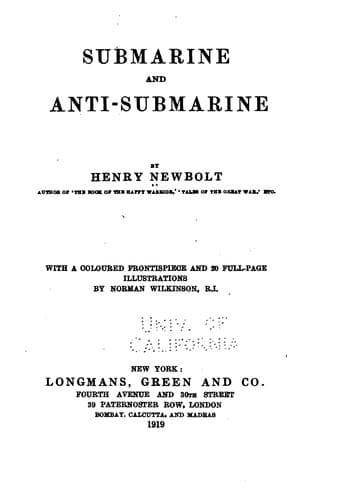
Submarine and Anti-submarineNewbolt, Henry John, Sir
History
Submarine and Anti-submarine
Newbolt, Henry John, Sir
Submarines (Ships); World War, 1914-1918 -- Naval operations -- Submarine
Notwithstanding this evidence, and the opinion of so many competent
witnesses, the Admiralty rule held good. There were no survivors or
dead bodies, no debris which might not have come from the submarine’s
deck, no certainty that she could not have righted herself and crawled
home to the repairing yard. The report was marked ‘Probably sunk,’
and a letter of appreciation was directed to be forwarded to each
of the three commanders, with an intimation that if any subsequent
information should be received which would cause any revision of the
classification, the case should be resubmitted. Less than seven weeks
afterwards the ‘subsequent information’ was forthcoming and thereupon
Lieutenant-Commander Coombs was awarded the D.S.O., and ‘Mentions’ were
given to Commanders Taylor and Gibbs, as well as to two ratings from
_Sturgeon_, and one rating each from _Retriever_ and _Thruster_. So
ends the plain story of what is, to the Destroyer Service, a day’s work
in the ordinary routine. But any other Service in the world will tell
you that there is nothing ordinary about it.
CHAPTER XIII
P-BOATS AND AUXILIARY PATROL
The trawler is a fishing-boat by birth, and a mine-sweeper by
necessity; the destroyer is first of all a fighting ship, and a
protector of the weak. They will both kill a submarine when it comes
their way; but we have ships--classes of ships--whose whole profession
and occupation it is to hunt the pirate. Their methods differ as the
methods of two kinds of hound. The Q-boat hunts slowly and craftily,
the P-boat and the Yacht Patrol by speed, the ram, and the dreaded
depth-charge. It is unnecessary to give the technical description of
either class. A yacht is a yacht, and for a P-boat you may imagine
a long slim boat, with fine lines and a rather low freeboard, three
officers, a surgeon, and some fifty-five men--depth-charges round the
stern and a gun or two, but no torpedoes.
In September 1917, H.M.S. P. 61 received orders to pick up in a certain
roadstead the oiler _San Zeferino_ and escort her to her destination.
It was no easy job; the _San Zeferino’s_ steering gear was defective,
she could not zigzag; and in the misty showers and very dark weather
prevailing, her course was embarrassingly original. But she was a
valuable ship, and P. 61 meant to get her in if it could be done.
Public-domain text, read in full here on John Shaqi.
Reviews
Reviews
No reviews yet
Be the first to share your thoughts on this work.
Elsewhere in the archive
Join the Discussion
Join the discussion
Sign in to leave a comment or review.
Sign InorCreate an account