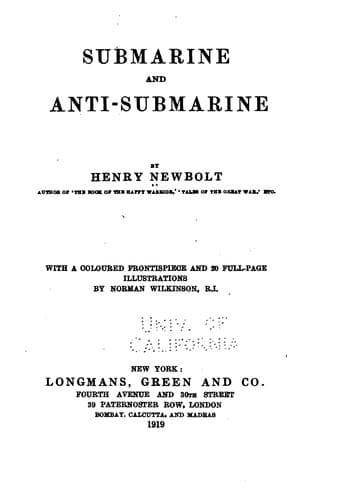
Submarine and Anti-submarineNewbolt, Henry John, Sir
History
Submarine and Anti-submarine
Newbolt, Henry John, Sir
Submarines (Ships); World War, 1914-1918 -- Naval operations -- Submarine
We may hear, too, what the commander of Q. 5 said about his officers
and crew. ‘They may almost be said to have passed through the supreme
test of discipline. The chief-engineer and the engine-room watch
remained at their posts and kept the dynamos going until driven out by
water. They then had to hide on top of the engine-room. The guns’ crews
had to remain concealed in their gun-houses for nearly half an hour,
while we could feel the ship going down by the stern. At that time it
appeared touch-and-go whether the ship would sink before we sank the
enemy. The officers and men who remained on board during the towing
also did splendidly, the conditions at times being most dangerous ...
it is difficult to select individuals where all did so well.’ But
without selecting, we may name two by their names: Engineer-Lieutenant
L. S. Loveless, R.N.R., and Lieutenant Ronald Stuart, R.N.R., First
and Gunnery Lieutenant, both now members of the Distinguished Service
Order. It is hardly necessary to add that their commander received the
Victoria Cross. He was born for it.
It is not often that any man, or any ship’s company, can repeat their
best performance and better it; yet Commander Campbell’s third victory
was followed by a fourth, of which, as the Admiral on his station said
truly, it is difficult to speak in sober terms. Four months after Q. 5
had struggled back to port, her men were out again in the _Pargust_,
a merchant vessel on the same Special Service. The ship was going 8
knots in heavy rain and mist, with a fresh southerly breeze and a
choppy sea. Like Q. 5, she got what she was looking for--what others
run fast and far to avoid. A torpedo was seen coming towards her on the
starboard beam. It was apparently fired at very close range, for it
had not yet settled down to its depth, but jumped out of the water
when only a hundred yards from the ship. This time there was no choice,
and no manœuvring; _Pargust_ received the shot in the engine-room and
near the water-line. It made a large rent, filled the boiler-room,
the engine-room and No. 5 hold with water, killed a stoker, wounded
Engineer Sub-Lieutenant John Smith, R.N.R., and blew the starboard
lifeboat into the air, landing pieces of it on the aerial.
The alarm had already been sounded and ‘Abandon ship’ ordered. The
three remaining boats--one lifeboat and two dinghies--were lowered,
full of men, the ship’s helm being put hard a-starboard to get a lee
for them. Lieutenant F. R. Hereford, R.N.R., as before, went in charge
of them and greatly distinguished himself by the coolness and propriety
with which he acted the part of Master of the supposed merchantman.
Public-domain text, read in full here on John Shaqi.
Reviews
Reviews
No reviews yet
Be the first to share your thoughts on this work.
Elsewhere in the archive
Join the Discussion
Join the discussion
Sign in to leave a comment or review.
Sign InorCreate an account