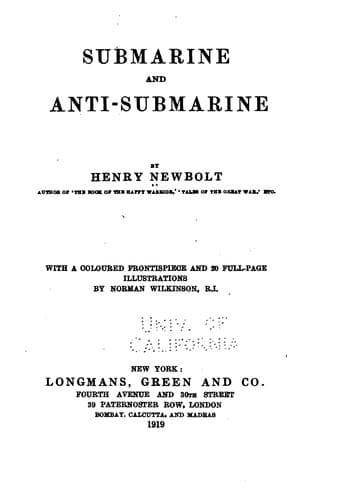
Submarine and Anti-submarineNewbolt, Henry John, Sir
History
Submarine and Anti-submarine
Newbolt, Henry John, Sir
Submarines (Ships); World War, 1914-1918 -- Naval operations -- Submarine
But it would be contrary to the principles of war and the genius
of our Navy, to rely upon purely defensive measures to defeat the
submarine enemy. It is sometimes said that the U-boat campaign took
us by surprise. So far as this applies to the legitimate use of the
submarine against war-ships, the statement is quite untrue. The
campaign against merchant shipping and non-combatant passengers, waged
in defiance of all international law and common humanity, did certainly
take us by surprise; and it is only to our credit, and the discredit
of our enemies, that their barbarity was beyond our imagination. But
the efforts of the U-boats against our fleet were, as we have shown
in a previous chapter, actually less successful than our own attacks
upon theirs, and our tacticians were never for a moment at a loss
to deal with them. The principles had been thought out long ago. As
early as 1907, the distinguished admiral who writes over the name
‘Barfleur’ clearly stated his belief that ‘the untried submarine’ was
not likely to prove more effective than the torpedo-boat and destroyer
in depriving our Battle Fleet of the control of the sea. ‘Nothing is
more to be deprecated,’ he added, ‘than the attempt which has been
made to enhance unduly its importance, by playing on the credulity
of the public. The new instrument of war has no doubt a value, but
that it is anything more than an auxiliary, with limited and special
uses, is difficult to believe.’ And he turned back to old and tried
principles: ‘The traditional role of the British Navy is not to act on
the defensive, but to prepare to attack the force which threatens.’
In September, 1914, when Weddigen’s _coup_ showed that the moment
had come, ‘Barfleur’ was among the first to attack the new problem
tactically--he saw at once that the war-ship’s best defence lies in the
offensive power given by her immense superiority in speed and weight.
And if the single ship is formidable to the submarine, a squadron
is still more so. By its formation, its manœuvres, its pace and its
ramming power, it reverses the whole situation--the hunter becomes the
hunted, and must fly like a wolf from a pack of wolf-hounds, every one
more powerful than itself.
Public-domain text, read in full here on John Shaqi.
Reviews
Reviews
No reviews yet
Be the first to share your thoughts on this work.
Elsewhere in the archive
Join the Discussion
Join the discussion
Sign in to leave a comment or review.
Sign InorCreate an account