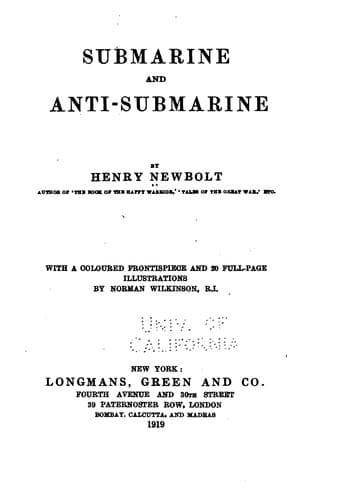
Submarine and Anti-submarineNewbolt, Henry John, Sir
History
Submarine and Anti-submarine
Newbolt, Henry John, Sir
Submarines (Ships); World War, 1914-1918 -- Naval operations -- Submarine
Our submarine campaign in the Sea of Marmora must also have a separate
chapter to itself, not only because it is now a closed episode in the
history of the War, but because it was conducted under quite unique
conditions. The scene of operations was not merely distant from the
submarine base, it was divided from it by an approach of unusual danger
and difficulty. The channel of the Dardanelles is narrow and winding,
with a strong tide perpetually racing down it, and setting strongly
into the several bays. It was moreover protected, as will appear in the
course of the narrative, by forts with powerful guns and searchlights
and torpedo tubes, and by barrages of thick wire and netting it was
also patrolled constantly by armed ships. Yet from the very first all
these defences were evaded or broken through with marvellous courage
and ingenuity; for nearly a year a succession of brilliant commanders
took their boats regularly up and down the passage, and made the
transport of Turkish troops and munitions across the Marmora first
hazardous, and finally impracticable. Their losses were small; but
they passed the weeks of their incredibly long patrols in continual
danger, and snatched their successes from the midst of a swarm of
vigilant enemies. Two battle-ships, a destroyer, and five gunboats
fell to them, besides over thirty steamers, many of which were armed,
nine transports, seven ammunition and store ships, and no less than 188
sailing-ships and dhows with supplies. The pages which follow contain
notes on the cruise of every British boat which attempted the passage
of the Straits; but they are far from giving an account of all their
amazing feats and adventures.
Lieutenant Norman Holbrook had the honour of being the first officer
to take a British submarine up the Dardanelles. He carefully prepared
his boat--B. 11--for the business of jumping over and under obstacles,
by devices which have since been perfected but were then experimental.
The preliminary trials turned out very satisfactorily, and on
Sunday, December 13, 1914, as soon as the mainland searchlights were
extinguished at dawn, he trimmed and dived for Seddul Bahr.
Public-domain text, read in full here on John Shaqi.
Reviews
Reviews
No reviews yet
Be the first to share your thoughts on this work.
Elsewhere in the archive
Join the Discussion
Join the discussion
Sign in to leave a comment or review.
Sign InorCreate an account