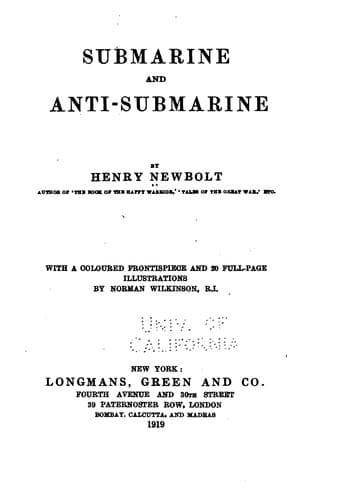
Submarine and Anti-submarineNewbolt, Henry John, Sir
History
Submarine and Anti-submarine
Newbolt, Henry John, Sir
Submarines (Ships); World War, 1914-1918 -- Naval operations -- Submarine
The first four days of May he spent mainly in being hunted. On the 5th,
he got a shot at a destroyer convoying a transport, and made a fine
right-angle hit at 600 yards, but the torpedo failed to explode. This
only whetted his appetite, and for three days he chased ship after
ship. One he followed inshore, but troops on board opened fire on him
and hit the boat several times. At last, on the evening of May 10,
after being driven down by one destroyer, he sighted another with two
transports, and attacked at once. His first torpedo missed the leading
transport; his second shot hit the second transport and a terrific
explosion followed. Debris and men were seen falling into the water;
then night came on rapidly, and he could not mark the exact moment at
which she sank.
Inside Constantinople they were already telling each other yarns about
E. 14, and for her incredible activity they even promoted her to the
plural number. ‘One of the English submarines in the Marmora,’ Mr.
Einstein wrote on May 11, ‘is said to have called at Rodosto, flying
the Turkish flag. The Kaimakam, believing the officers to be German,
gave them all the petrol and provisions they required, and it was only
after leaving that they hoisted their true colours.’ The story will not
bear examination from our side; but no doubt it very usefully covered
a deficiency in the Kaimakam’s store account, whether caused by Germans
or by the Faithful themselves.
On May 13, Lieut.-Commander Boyle records a rifle duel with a small
steamer which he had chased ashore near Panidos. On the 14th he remarks
the enemy’s growing shyness. ‘I think the Turkish torpedo-boats must
have been frightened of ramming us, as several times, when I tried to
remain on the surface at night, they were so close when sighted that
it must have been possible to get us if they had so desired.’ The air
was so clear that in the daytime he was almost always in sight from the
shore, and signal fires and smoke columns passed the alarm continually.
He had no torpedoes left and was not mounted with a gun, so that he
was now at the end of his tether. On the 17th he was recalled by
wireless, and after diving all night ran for Gallipoli at full speed,
pursued by a two-funnelled gunboat, a torpedo-boat and a tug, who
shepherded him one on each side and one astern, ‘evidently expecting,’
he thought, ‘to get me caught in the nets.’ But he adds,’did not notice
any nets,’ and after passing another two-funnelled gunboat, a large
yacht, a battle-ship and a number of tramps, the fire of the Chanak
forts and the minefield as before, he reached the entrance and rose
to the surface abeam of a French battle-ship of the St. Louis class,
who gave her fellow crusader a rousing cheer. Commander Boyle reported
that the success of this fine and sustained effort was mainly due to
his officers, Lieutenant Edward Stanley and Acting-Lieutenant Lawrence,
R.N.R., both of whom received the D.S.C. His own promotion to Commander
Public-domain text, read in full here on John Shaqi.
Reviews
Reviews
No reviews yet
Be the first to share your thoughts on this work.
Elsewhere in the archive
Join the Discussion
Join the discussion
Sign in to leave a comment or review.
Sign InorCreate an account