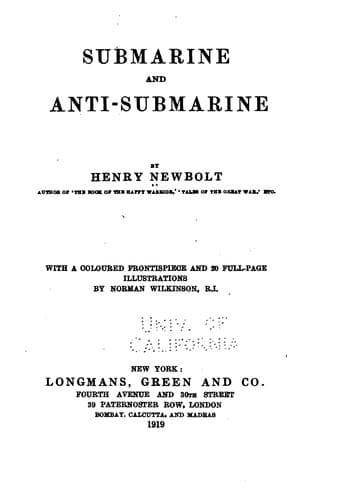
Submarine and Anti-submarineNewbolt, Henry John, Sir
History
Submarine and Anti-submarine
Newbolt, Henry John, Sir
Submarines (Ships); World War, 1914-1918 -- Naval operations -- Submarine
Left to herself, E. 2 now found that she also possessed a heroic
lieutenant. Under the date September 7 there stands the brief record:
‘Lieutenant Lyon swam to and destroyed two dhows.’ The story, so
well begun, ends next day. At 2.15 A.M. this adventurer, like the
other, swam off with a raft and bag of gun-cotton. His object, like
the other’s, was to destroy a railway bridge. His friends watched
him until, at seventy yards’ distance, he faded into the dusk. From
that moment onwards no sound was ever heard from him. The night was
absolutely still, and noises on shore were distinctly audible; but
nothing like a signal ever came. It had been agreed that if any trouble
arose he should fire his Webley pistol, and the submarine should then
show a red light and open fire on the station, which was 300 yards
distant. For five hours she remained there waiting. An explosion was
heard, but nothing followed, and broad daylight found Commander Stocks
still waiting with desperate loyalty. At 7.15 he dived out to sea. An
hour later he came to the surface and cruised about the place, hoping
that Lyon had managed somehow to get into a boat or dhow. There were
several near the village, and he might be lying off in one. But no boat
drifted out, then or afterwards. Commander Stocks came again at dawn
next day--perhaps, as he said, to bombard the railway station, perhaps
for another reason. Six days later he dived for home, breaking right
through the Nagara net, by a new and daring method of his own.
It was now Lieut.-Commander Bruce’s turn again, and he passed all
records by patrolling the Marmora successfully in E. 12 for forty days.
He had two other boats in company during part of this time--E. 20
and H. 1--and with the latter’s help he carried out a very pretty
‘spread attack’ on a gunboat off Kalolimno, on October 17. The
intended manœuvre was for E. 12 to rise suddenly and drive the enemy
by gunfire over H. 1, who dived at the first gun. The first drive
failed, the second was beautifully managed; but, in the bad light of an
approaching squall, H. 1’s torpedo missed. In a third attempt the bird
was reported hit by several shells, but she escaped in the darkness.
Lieut.-Commander Bruce also did good shooting at a powder factory
near Constantinople; sank some shipping, and made some remarkable
experiments with a new method of signalling. But his greatest
experience was his return journey.
Public-domain text, read in full here on John Shaqi.
Reviews
Reviews
No reviews yet
Be the first to share your thoughts on this work.
Elsewhere in the archive
Join the Discussion
Join the discussion
Sign in to leave a comment or review.
Sign InorCreate an account