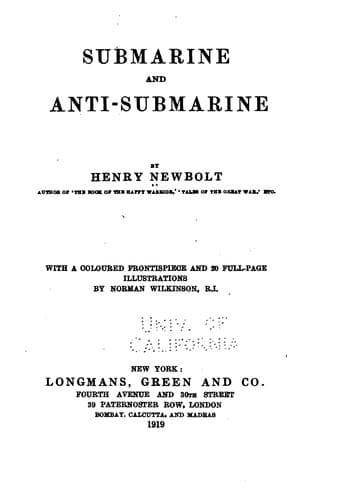
Submarine and Anti-submarineNewbolt, Henry John, Sir
History
Submarine and Anti-submarine
Newbolt, Henry John, Sir
Submarines (Ships); World War, 1914-1918 -- Naval operations -- Submarine
Anger it must still be, however grave and temperate. Look at the
conduct of the War, and especially at the conduct of the submarine war,
as coolly and scientifically as you can, you will not find it possible
to separate the purely military from the moral aspect. Technically, the
Germans were making trial of a new weapon which it was difficult to
use effectively under the old rules. They quickly determined, not to
improve or adapt the weapon, but to abandon the rules. For this they
were rightly condemned by the only powerful neutral opinion remaining
in the world. But they not only broke the law, they broke it in German
fashion. Their lawlessness, if skilfully carried out with the natural
desire to avoid unnecessary suffering, might have been reduced to an
almost technical breach, involving little or no loss of life. But
they chose instead to exhibit to the world, present and to come, the
spectacle of a whole Service practising murder under deliberate orders;
and adding strokes of personal cruelty hitherto known only among
madmen or merciless barbarians. Finally--and this concerns our future
intercourse even more nearly--the German people at home, a nation
haughtily claiming pre-eminence in all virtue, moral and intellectual,
accepted every order of their ruling caste, and applauded every act of
their hordes in the battle, however abhorrent to sane human feeling. In
all this, we need make no accusations of our own; we have only to set
out the facts, and the words with which the German people and their
teachers received them and rejoiced in them.
It was towards the end of 1914 that the German Admiralty conceived the
idea of blockading the British Isles by means of a submarine fleet.
There were, as we have already seen, great difficulties in the way.
For the pursuit and capture of commerce, a submarine is not nearly so
well fitted as an ordinary cruiser; is not, in fact, well fitted at
all. To hold up and examine a ship on the surface is too dangerous a
venture for a frail boat with a very small crew; to put a prize crew on
board, and send the captured vessel into port, is generally impossible.
As an exception, and in case of extreme necessity, it has always been
recognised that a prize may be sunk, if the crew and passengers are
safely provided for; but this proviso, too, is almost impossible for a
submarine to fulfil. Besides these technical difficulties, there was
also the danger of offending neutral powers, especially if their ships
were to be sunk without evidence that they were carrying contraband.
Public-domain text, read in full here on John Shaqi.
Reviews
Reviews
No reviews yet
Be the first to share your thoughts on this work.
Elsewhere in the archive
Join the Discussion
Join the discussion
Sign in to leave a comment or review.
Sign InorCreate an account