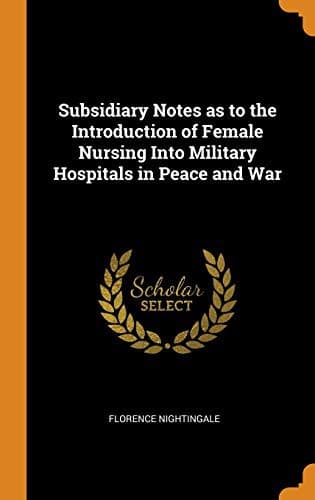
Subsidiary Notes as to the Introduction of Female Nursing into Military Hospitals in Peace and WarNightingale, Florence
History
Subsidiary Notes as to the Introduction of Female Nursing into Military Hospitals in Peace and War
Nightingale, Florence
Military hospitals -- Great Britain; Nurses -- Great Britain
6. Provided this double range of windows be secured, double wards of
thirty on the same floor would cause no disadvantage to the sick.
But, if such be determined on, let especial care be taken to separate
the two, not by a showy hall, but by a lobby and an ample staircase,
extending from top to bottom of the building, and communicating freely
with the open air at the roof, as well as by the stair-windows:
admitting a thorough current of external air, so that, of a morning
especially, the two wards do not mutually send the close air into each
other.
The lobby should not be turned into a vestibule. Thorough air is all
that is wanted. Patients should not be suffered to remain in it.
[Sidenote: Material of Ward Utensils.]
7. The material of the different utensils required for ward service
should be settled. In the use of glass or earthenware for all
eating, drinking, and washing vessels there is great superiority as
to cleanliness, and the saving of time and labour in cleaning these
materials, to those of tin or other metal. Still two things have to be
weighed against these great advantages. First, if these vessels are
cleaned by Ward-Orderlies, the amount of breakage would be much greater
in proportion than as done by Nurses, and it is imperative to have as
few women as possible in the service of Military Hospitals. Secondly,
it is very important to avoid even the appearance, especially at first,
of anything like introducing luxury into Army Hospitals; and I can
quite understand this appearing like luxury.
The material of one description of ward-vessels should in particular be
left to the Surgeons. In sending to distant foreign or war-stations,
urinals of tin have one material advantage over those of glass or
china, that they do not break so easily; but, as to home-service,
these tin urinals cannot, by any amount of cleaning, be freed from an
unclean smell. In Vienna General Hospital, where economy is exceedingly
attended to, all the urinals are of glass, as the superior cleanliness
is considered well worth the additional expense. A damaged or broken
glass or earthenware urinal is dangerous; and if there is difficulty in
obtaining the immediate issue of a new for a damaged one, it is better
to have tin.
In Vienna General Hospitals the patients’ eating vessels were formerly
of tin; but were some time ago furnished of earthenware, for the same
reasons as those given above; also because the hot tin vessels were
found awkward to the patients. (I do not think much of this latter
reason; in hospitals, there is little fear of food reaching the
patients too hot). In Vienna and Berlin Military Hospitals the eating
vessels are all of tin.
[Sidenote: Reserve Wards.]
Public-domain text, read in full here on John Shaqi.
Reviews
Reviews
No reviews yet
Be the first to share your thoughts on this work.
Elsewhere in the archive
Join the Discussion
Join the discussion
Sign in to leave a comment or review.
Sign InorCreate an account