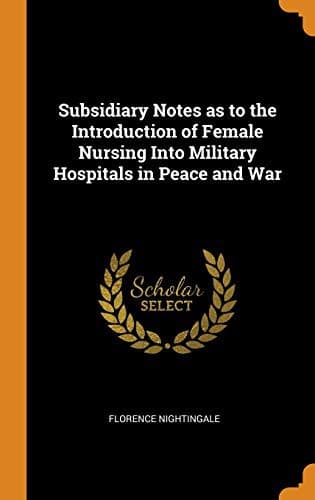
Subsidiary Notes as to the Introduction of Female Nursing into Military Hospitals in Peace and WarNightingale, Florence
History
Subsidiary Notes as to the Introduction of Female Nursing into Military Hospitals in Peace and War
Nightingale, Florence
Military hospitals -- Great Britain; Nurses -- Great Britain
Of course widows and unmarried women who are not mothers do the above
things; but there cannot be a doubt of the additional and terrible
temptation to women burdened with children, to make money in various
ways out of their patients. Even in the most favourable cases (and it
is to be feared they are few) where the real good principle of the
mother restrains her from venality, there are still serious objections.
The time when a nurse can go out must necessarily be comparatively very
limited. The time that is enough for the moderate demands of friendship
or acquaintance is miserably insufficient for the natural yearnings
of the mother, especially if the children are young and helpless. The
consequence is that, either openly or by stealth, she goes to them
or has them brought to her at unallowed times; or, if the rules of
the hospital are lax as to visitors, the children are perpetually
with her: and let it be remembered, that the head-nurse’s room or
rooms are usually at the entrance of the ward, that being infinitely
the best place. It is difficult to say whether such a practice is
most objectionable as regards the children, or the patients, or the
hospital; and whether it is most objectionable when the children are
young, or adolescent, or grown up. It is objectionable in all and every
one of these cases. And no less objectionable is it in the case of the
assistant-nurse, who where the rules are lax will receive her children
either in the ward or in the nurses’ kitchen; or where they are strict,
will have the children come about the hospital and will meet them on
the sly.
These things enter immensely, minute as they seem, into the discipline
of wards and of the hospital; and discipline means a great deal.
Sanitary objects.
[Sidenote: Sanitary Objects.]
[Sidenote: To discourage admission of women physically unfit.]
A good many nurses enter hospital service who are quite unfit for it.
Often consumptive and ruptured women, those suffering from piles or
prolapsus, &c., present themselves, are admitted, struggle on for a
time, and break down with or without taking to drink. Undoubtedly, none
but strong healthy women should enter hospital service; the work will
wear them out quite soon enough, and some of the above complaints are
particularly liable to follow the work.
Here again men of business must advise: the fund ought to have some
efficient though not infallible security as to the average good health
on joining of its members. Life Insurance rules as to this would be to
the point.
Believe me, all these things are important.
Moral objects.
[Sidenote: Moral Objects attainable.]
The most difficult part of a difficult thing, only perhaps it is at the
same time the most important.
[Sidenote: Need of Certificates.]
Public-domain text, read in full here on John Shaqi.
Reviews
Reviews
No reviews yet
Be the first to share your thoughts on this work.
Elsewhere in the archive
Join the Discussion
Join the discussion
Sign in to leave a comment or review.
Sign InorCreate an account