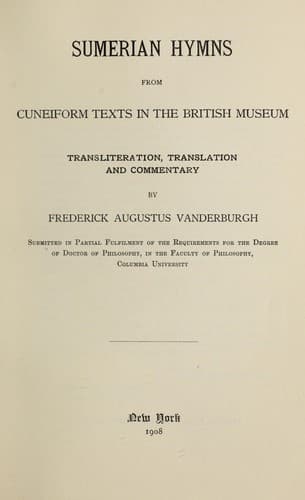
Sumerian Hymns from Cuneiform Texts in the British Museum
Religion
Sumerian Hymns from Cuneiform Texts in the British Museum
Hymns, Sumerian; Sumerian language -- Texts
_û um-me-ši-lá-lá_ (see line 16). This interesting statement on the
flood agrees entirely with the story of the flood in the Eleventh Tablet
of the Babylonian Epic of Gilgameš. The difference between the length of
the Hebrew and that of the Babylonian deluge is significant. The
narrative of Pirnapištim, the Babylonian Noah, is quite graphic. He
represents the gods as seated weeping, their lips covered in fear. Six
days and nights the wind blew. When the seventh day appeared, the storm
subsided, the sea began to dry and the flood was ended. He looked upon
the sea, mankind was turned to clay, corpses floated like reeds. He
opened the window. He sent forth a dove which returned. He sent forth a
raven, which saw the carrion on the water, ate, and wandered away, but
did not return. He built an altar on the peak of the mountain and set
forth vessels by sevens. The gods smelled the savour and gathered to the
sacrifice, and the great goddess lifted up the rainbow which Anu had
created. Those days he thought upon and forgot not.
19. _û ì di-zu-ka ḥàr-ḥa-ra ab-ba û um-me-ši-lá-lá_
It was the day of the word of thy judgment, O bull-god of the abyss,
the day thou didst look.
_û_ (line 16).
_ì_ equals _amâtu_, “word” (Br. 518, see also Hymn to Sin, line 16).
_di-zu-ka_: _di_ equals _dênu_, “judgment” (Br. 9525 and Hymn to Bêl,
line 7). _zu_ (Hymn to Bêl, line 21). _ka_ = _nota genitivi_ (Hymn to
Bêl, line 1).
_ḥàr-ḥa-ra_ is the same as _ḥàr-ḥar-a_. _ḥàr_ is a value of GUṬṬU,
meaning _ḳardu_, “heroic one” (MSL. p. 174). We have had the sign with
the value _gù_ (Hymn to Bêl, line 9). _ḥa-ra_, phonetic representation
of _ḥàr-a_, with the same meaning as _ḥàr_ of GUṬṬU, plus phonetic
complement.
_ab-ba_: _ab_ equals _tâmtu_, “sea” (Br. 3822). The common word for
“sea” is AB.ZU, written ZU.AB, meaning “sea of wisdom”, the abode of Ea,
the god of wisdom. _ab_ also equals _aptu_, “abyss” (Br. 3815). _ab_,
“sea”, or “abyss” is a shortened form of _a-ab_, “water enclosure”,
“water space”. AB with the value _éš_ we have had (Hymn to Sin, line
10).
_û um-me-ši-lá-lá_ (line 16).
20. _nim-gir luḥ su-ši-šù mu-ra-du-ud_
As the lightning, a messenger for terror, thou didst go.
_nim-gir_ equals _birḳu_, “lightning” (Br. 9020). _nim-gir_ literally
means “high lightning”. _nim_ equals _elû_, “high”. _gir_ alone equals
_birḳu_ (Br. 306). The sign GIRÛ in its primitive form is a picture of a
“dagger”. From the conception of the “dagger”, there is, of course, but
a short step to that of the forked lightning.
_luḥ_ equals _sukkallu_, “messenger” (Br. 6170). We have had the sign
SUKKALLU with the value _laḥ_ (line 14, _laḥ_, and Hymn to Sin, line
27).
_su-ši-šù_ equals noun _su-ši_ and postposition _šù_. _su-ši_: SU.ŠI
means “increase of eye” and eqnals _šalummatu_ which means “splendour”,
or perhaps “terror”. SU.ŠI might be read _su-lim_. SU.ZI, however, has
the same meaning (see Br. 235 and 187, also MSL. p. 298), proving the
reading SU.ŠI.
Public-domain text, read in full here on John Shaqi.
Reviews
Reviews
No reviews yet
Be the first to share your thoughts on this work.
Join the Discussion
Join the discussion
Sign in to leave a comment or review.
Sign InorCreate an account