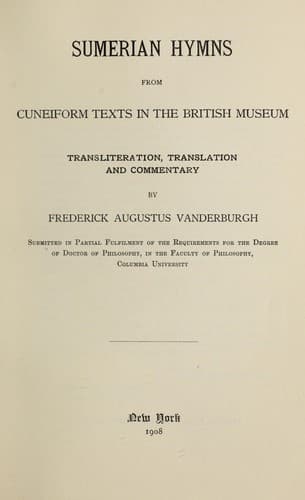
Sumerian Hymns from Cuneiform Texts in the British Museum
Religion
Sumerian Hymns from Cuneiform Texts in the British Museum
Hymns, Sumerian; Sumerian language -- Texts
_mu-ra-du-ud_: _mu_ (see Hymn to Bêl, line 18). _ra_ is an infix of
adverbial character denoting motion (MSL. p. XXIV). _du-ud_ is no doubt
for _du-du_, an intensified form of _du_ (see Hymn to Bêl, line 23,
_gin_).
21. _mulu dumu-mu rù gin-na-gin-na a-ba zi-gi-en te-ga_
When thou who art my son goest violently about, who can attack like
thee?
_mulu dumu-mu_ (see on line 16).
_rù_ equals _naḳâpu_, “break forth violently”, or “storm furiously”,
(Br. 9144). Here we come near to the primary idea of the sign which is
that of “the goring bull” (see Hymn to Sin, line 14).
_gin-na-gin-na_: DU = _alâku_ may have any one of three values, _gin_,
_tum_ or _rà_ (Br. 4871). _gin_ is the correct value here, as is shown
by the phonetic complement _na_. The value _du_ must be closely related
to _tum_ and _gin_. _du_ by change of _d_ to _t_ and by addition of the
nasal _m_ becomes _tum_. _tum_ by change of _t_ to _g_, of _u_ to _i_
and of _m_ to _n_ becomes _gin_.
_a-ba_ equals _mannu_, “who” (Br. 11370). See also below.
_zi-gi-en_ probably is a phonetic and dialectic form for _za-e-gim_
(line 22).
_te-ga_: _te_ equals _ṭeḥû_, “attack” (Br. 7688). _ga_: BA is probably
dialectic for _ga_ (Br. 103) which would be the same as PISANNU, i. e.,
_bašû_, “being”, or _šakânu_, “establishing”.
Reverse
22. _ki-bala ḥul gíg a-a muḥ-zu-šù a-ba za-e-gim te-ga_
The troublesome evil hostile land, O father, which is against thee,
who like thee can attack!
_ki-bala_: _ki_ (see Hymn to Bêl, line 9). _bala_ equals _palû_,
“weapon” (Br. 276). From the idea of “weapon”, it is easy to pass to
that of “hostility”, expressed by _nukurtu_ (Br. 272).
_ḥul_ equals _limnu_, “bad” (see Br. 9502 and Hymn to Sin, line 16,
_ḥùl_).
_gíg_ equals _mar⋅u_, “sick” (Br. 9235). The sign is composite, the
principal element of which is MI meaning “black”.
_a-a_ (see Hymn to Bêl, line 3).
_muḥ-zu-šù_: _muḥ_ equals _eli_, “upon”, or “against” (Br. 8841). _zu_
(Hymn to Bêl, line 21). _šù_ (Hymn to Bêl, line 15) governs the phrase
_muḥ-zu_.
_a-ba_ (see on line 21).
_za-e-gim_: _za-e_ (see Hymn to Bêl, line 16). _gim_ (see line 12).
_te-ga_ (see on line 21).
23. _ná imi tur-tur-e šú-um-me-ti a-ba za-e-gim te-ga_
The little stone of the storm do thou take. Who can attack like
thee!
_ná_: DAḲḲU has three values for _abnu_, “stone”, _za_, _⋅i_ and _ná_.
We have also had the sign ZA with the value _za_ equal to _abnu_ (line
13). No doubt DAḲḲU indicates “hailstone” here.
_imi_ is the common value of the sign IMMU for _šâru_, “storm” (Br.
8369).
_tur-tur-e_: _tur_ (see Hymn to Sin, line 28, _ban-da_). The sign is
DUMU (lines 3, 15 and 16). _e_ (see Hymn to Bêl, line 3).
Public-domain text, read in full here on John Shaqi.
Reviews
Reviews
No reviews yet
Be the first to share your thoughts on this work.
Join the Discussion
Join the discussion
Sign in to leave a comment or review.
Sign InorCreate an account