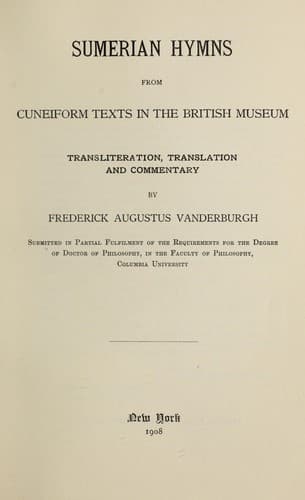
Sumerian Hymns from Cuneiform Texts in the British Museum
Religion
Sumerian Hymns from Cuneiform Texts in the British Museum
Hymns, Sumerian; Sumerian language -- Texts
The salient phases of the rounded out Tammuz story are touched upon in
this hymn; viz., his local dwelling in a city where he had a temple; the
memorial weeping; his relation to Anu; his lordly power; his
specification as “a brother”; his relation to the goddess Ištar; his
characteristic and supreme function of plant-germination. Note also that
he was the agricultural god of spring vegetation. Offerings of wine were
poured out over his bier, he having been humbled to sorrow by banishment
to the lower world, where he became a lord over the occult and internal
forces inherent beneath the soil of the earth. So he became a god of a
new life. The hymn does not seem altogether to confine the germinating
work of Tammuz to the vegetation of spring growth, but appears,
especially in the Reverse, to include fruit growing which might come
later in the season. Possibly this hymn was sung as a dirge at
Babylonian anniversaries for the departed Tammuz. The Babylonians at the
time of the summer solstice annually commemorated with lamentation the
departure of Tammuz to the lower world. He had instructed them that they
should gather at his bier and that hired musicians should sing and play
and that the people should sacrifice and drink wine.
Obverse
1. _šes-e tuš-e-na eri êr-ra na-nam_
To the brother whose dwelling is the city of weeping, thus:
_šes-e_: _šes_ same as _šis_ (Hymn to Sin, line 2). _e_ equals _ana_,
“to” (Br. 5847).
_tuš-e-na_: _tuš_ equals _ašâbu_, “dwell” (Br. 10523). Probably the sign
has the same value for _šubtu_, “dwelling” (Br. 10553). We have had the
sign (KU) with the value _šù_ (Hymn to Bêl, line 15). _e_, vowel of
prolongation. _na_, pronominal suffix (see Hymn to Adad, line 27).
_eri_ (Hymn to Bêl, line 13).
_êr-ra_: _êr_ (Hymn to Bêl, Colophon). _ra_, phonetic complement (Hymn
to Bêl, line 3).
_na-nam_ equals _kîam_, “thus” (see Br. 1597 and Hymn to Adad, line 28).
The words “O my brother” are represented in legend as being first
uttered by the sister of Tammuz and then taken up by other mourners.
Probably the custom of weeping for Tammuz originated in the city of
Eridu.
2. _a-kala šes-e tab An-na_
The mightiness of the brother, the companion of Anu!
_a-kala_ is an abstract noun like _nam-kala_ which is equal to _dannûtu_
(Br. 6194). _a_ is an abstract prefix, as in A.DU, equal to _a-rá_,
“going” (MSL. p. XVII). _kala_ equal _dannu_, “mighty” (Br. 6194).
_šeš-e._ See on _šes_ (line 1). _e_, probably sign of the genitive, if
not merely a vowel of prolongation. It can certainly be a postposition
(see on line 1).
_tab_ (see Hymn to Adad, line 6).
Public-domain text, read in full here on John Shaqi.
Reviews
Reviews
No reviews yet
Be the first to share your thoughts on this work.
Elsewhere in the archive
Join the Discussion
Join the discussion
Sign in to leave a comment or review.
Sign InorCreate an account