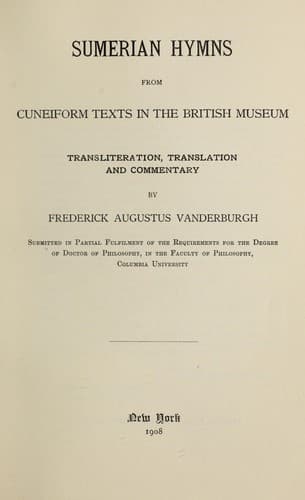
Sumerian Hymns from Cuneiform Texts in the British Museum
Religion
Sumerian Hymns from Cuneiform Texts in the British Museum
Hymns, Sumerian; Sumerian language -- Texts
_An-na_ (see Hymn to Adad, line 3 and Hymn to Bêl, line 18). Tammuz was
a companion of Gišzida in the dominion of Anu. Gišzida was also a god of
vegetable growth. At a certain period of the year, Tammuz and Gišzida
were stationed in companionship as attendants at the gate of heaven.
Here the power of Tammuz to cause vegetation to grow began to be
effective. He was, in the first days of his existence, a sun-god, and,
stationed in heaven, the rays of his power were felt on earth. So,
probably every year, at the time of spring growth, he was conceived of
as operating from heaven like a sun.
3. _a-kala à-ba en ^dimmer Dumu-zi_
The mightiness of his power, the lord Tammuz!
_a-kala_ (see on line 2).
_à-ba_: _à_ (see Hymn to Bêl, line 14). _ba_ (Hymn to Adad, line 25).
_en_ (see Hymn to Bêl, line 19).
_^dimmer Dumu-zi_. _Dumu-zi_ means “son of life”. _Dumu_ (Hymn to Sin,
line 5). _zi_ (see Hymn to Bêl, line 23).
4. _dumu è-gal-a-ni nu mu-un-su-ga-mu_
The son whose temple is not far away!
_dumu_ (see Hymn to Sin, line 5, _ṭu-mu_).
_è-gal-a-ni_: _è-gal_ equals _êkallu_, “temple”, (Br. 6252). È.GAL,
“great house”, is the common compound ideogram for “temple”, both in
Sumerian and Assyrian. The Assyrian _êkallu_ is evidently the Sumerian
_è_, plus _gal_ which is changed to _kal_. The word has passed over into
Hebrew, Syriac and Arabic. _è_ (see Hymn to Sin, line 3). _gal_ (see
Hymn to Bêl, line 14). _è-gal_ is often followed by _la_; here, however,
it is followed by _a_, showing that the phonetic use of _la_ and _a_ is
quite similar. _ni_ (see Hymn to Bêl, line 13).
_nu_ (Hymn to Sin, line 27).
_mu-un-su-ga-mu_ is a verb and seems to mean “who is far away”. The
clause occurs also in lines 6, 8, 10 and 12, only that in lines 6 and 12
SU is used instead of SUD. _mu-un_ (see Hymn to Sin, line 17). _su_: SUD
seems to equal _rûḳu_, “distant”, here. Yet when it is equal to _rûḳu_,
it generally has the value _sud_ and is followed by the phonetic
complement _da_; here it is followed by _ga_. So the value should be
_sug_ or _su_. _mu_ is a relative suffix related to _mu_ of _mu-un_ (see
Hymn to Adad, line 16).
5. _azag ^dimmer Nanâ-ge è An-na-ka im-me_
The shining one of Ištar, who is in the house of Anu!
_azag_ (see Hymn to Sin, line 1).
_^dimmer Nanâ-ge_. _Nanâ_, also written _Nanna_, is the Sumerian name of
Ištar. NANNU is sometimes written like RI which, when preceded by the
god-sign, also equals “Ištar”. _ge_ (see Hymn to Adad, line 4).
_è_ (see Hymn to Sin, line 3).
_An-na-ka_ (see Hymn to Adad, line 4). _ka_ equals _nota genitivi_ (see
Br. 551 and Hymn to Bêl, line 1).
Public-domain text, read in full here on John Shaqi.
Reviews
Reviews
No reviews yet
Be the first to share your thoughts on this work.
Elsewhere in the archive
Join the Discussion
Join the discussion
Sign in to leave a comment or review.
Sign InorCreate an account