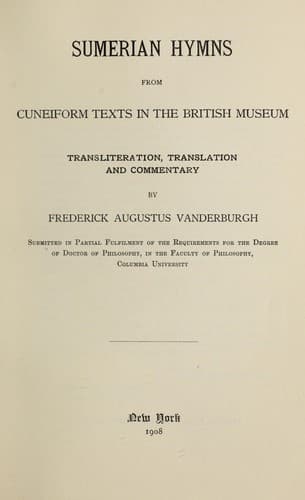
Sumerian Hymns from Cuneiform Texts in the British Museum
Religion
Sumerian Hymns from Cuneiform Texts in the British Museum
Hymns, Sumerian; Sumerian language -- Texts
_im-me_: _im_ (see Hymn to Sin, line 23). _me_ (Hymn to Bêl, line 16).
Tammuz seems to be the shining one. The epithet “shining” is sometimes
applied to gods, goddesses, kings, princes and others. The primary
relation of Tammuz was that of lover. But in the lower world he made
love to another. But each year during the season of vegetable growth he
was supposed to be living with Ištar and during the season of vegetable
decline he was supposed to be living with the other whom he loved in the
regions below. The house of Anu might mean the temple of Anu, but the
reference in this line is no doubt to heaven, over which Anu was lord
and at whose portals Tammuz sometimes acted as porter.
6. _mulu ú-sun-na-ge nu mu-un-su-ga-mu_
The one of plant-germination, who is not far away!
_mulu_ (see Hymn to Adad, line 16).
_ú-sun-na-ge_: _ú-sun_ seems to be a compound noun meaning
“plant-growing”. It occurs eight times in the hymn. _ú_ equals _šammu_,
“plant” (Br. 6027). It is sometime a determinative before the name of a
plant (Br. 6029). _sun_ means “irrigate” (MSL. 299). It is improbable
that this sign is KIB. _ge_ (see Hymn to Adad, line 4).
_nu_ (see Hymn to Sin, line 27).
_mu-un-su-ga-mu_ (see line 4). _su_(SU) and _su_(SUD,SUG) are
interchangeable (Br. 7593).
7. _azag ^dimmer Nanâ-ge za NANNA Unug-ka im-me_
The shining one of Ištar, who is the NANNA-stone of Erech!
_azag ^dimmer Nana-ge_ (see on line 5).
_za_: the probable meaning of _za_ here is “stone” (see Hymn to Adad,
line 13).
NANNA: there are no citations in Brünnow showing the meaning of NANNA
when standing alone. _za_-NANNA-_di_ equals _mammû_, “snow”, and
_za_-NANNA may mean “white stone”. If NANNA can equal UŠLANU-GUNÛ, then
it can mean _nasâḳu_ (Br. 3019) and _za_-NANNA means “shining stone”. It
may be that NANNA stands for UŠLANU-GUNÛ, then ZA.NANNA.UNU.KI could be
equal to _Unug-^ki_ (Br. 11749), and the line would read _azag ^dimmer
Nanâ-ge Unug-^ki-ka im-me_, “the shining one of Ištar of Erech he is”.
_Unug_: that _Unug_ is the correct value is shown by the phonetic
complement _ga_ that often follows UNU. Erech, we know, was the city of
Ištar (Br. 3023). _unu_ (see Hymn to Sin, line 2). _ka_ (line 5).
_im-me_ (see on line 5).
8. _mulu zib-ba-ra-ge nu mu-un-su-ga-mu_
The one of speech, who is not far away!
_mulu_ (see Hymn to Adad, line 16).
_zib-ba-ra-ge_: _zib-ba_ (see Hymn to Sin, line 16, _gu_). _ra_ must
answer for vowel prolongation (Hymn to Bêl, line 3). _ge_ (see Hymn to
Adad, line 4). “One of speech” must mean the god endowed with
authoritative utterance on the subject of germination.
_nu mu-un-su-ga-mu_ (see on line 4).
9. _bara-ka azag ^dimmer Nanâ-ge te ki-ka im-me_
In the temple the shining one of Ištar, who is the foundation of the
land!
_bara-ka_: _bara_ equals _parakku_, “dwelling room in the temple” (Br.
6878). _ka_ (line 5).
_azag ^dimmer Nanâ-ge_ (line 5).
_te_ equals _temennu_, “foundation” (Br. 7710).
Public-domain text, read in full here on John Shaqi.
Reviews
Reviews
No reviews yet
Be the first to share your thoughts on this work.
Elsewhere in the archive
Join the Discussion
Join the discussion
Sign in to leave a comment or review.
Sign InorCreate an account