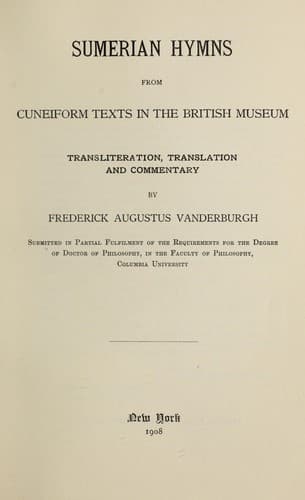
Sumerian Hymns from Cuneiform Texts in the British Museum
Religion
Sumerian Hymns from Cuneiform Texts in the British Museum
Hymns, Sumerian; Sumerian language -- Texts
_a-na-ám_ (line 14).
_mu-un-ma-al_: _mu-un_ (Hymn to Sin, line 17). _ma-al_ is the verb (Hymn
to Bêl, line 11).
Reverse
24. _è kaš-a-ka è gurun-na-ka dumu mulu azag zu-ge sigišše sag
tuk-a-na_
In the house of wine, in the house of fruit, the son, the shining
one of wisdom, who has a great sacrifice!
_è kaš-a-ka è gurun-na-nka dumu mulu azag zu-ge_ (line 21).
_sigišše_ (line 18).
_sag_ (Hymn to Bêl, line 5).
_tuk-a-na_: _tuk_ equals _išû_, “have” (Br. 11237). _a_, vowel of
prolongation (Hymn to Bêl, line 9). _na_, suffix of the third person
(Hymn to Bêl, line 1).
25. _ur-sag ^giš ku-a sag-mal-mal-ge_
The hero of great weapons!
_ur_ equals _amêlu_, “man” (Br. 11256).
_sag_ (Hymn to Bêl, line 5). _ur-sag_ means “head-man”, and is also
equal to _ḳarradu_, “mighty one”.
_^giš ku-a_: _^giš_ equals _i⋅u_, “wood”, and is a determinative before
names of things made of wood. _ku_ equals _bêlu_, “weapon”, perhaps
sacrificial implements. _a_, vowel of prolongation.
_sag-mal-mal-ge_: _sag_ (just explained). _mal-mal_: PISANNU is
dialectic for either MA.AL or IḲU and as a suffix makes an adjective of
a noun (see Hymn to Bêl, lines 1 and 18). _ge_ (see Hymn to Adad, line
4).
26. _dimmer mutin An-na-ge ú-sun-na sag-mal-mal-ge_
The wine god of Anu, the great plant-germinator!
_dimmer mutin An-na-ge_ (line 13).
_ú-sun-na_ (line 6).
_sag mal-mal-ge_ (line 25).
27. _ú-sun gurun-gurun ú-sun gurun-gurun šes-mu ú-sun gurun-gurun_
The germinator of many fruits, the germinator of many fruits, my
brother, the germinator of many fruits!
_ú-sun_ (line 6).
_gurun-gurun_, plural form of _gurun_ (line 21).
_šes-mu_: _šes_ (line 1). _mu_ (Hymn to Adad, line 16).
28. _ú-sun a-ra-li ú-sun gurun-gurun šes-mu ú-šun gurun-gurun_
The germinator of the lower world, the germinator of many fruits, my
brother, the germinator of many fruits!
_ú-sun_ (line 6).
_a-ra-li_ has passed over into Assyrian as _arallû_, “lower world”.
_a-ra-li_ is phonetic. There is a sign, URUGAL, translated by _arallû_.
URUGAL consists of the “enclosure” sign containing the sign GAL and
means “great house”. _è-kur-be_ is also translated by _arallû_ and is
equal to _bît mûti_, “house of the dead” (Br. 6259); more literally the
meaning is “house of the land of the dead”.
_ú-sun gurun-gurun šes-mu_ (line 27).
29. _in-nu gíš ^giš gu-ga-ge tàl-ta-al-ta-al mu-ib-rá-rá_
The vegetable germinator(?), the only plant begetter, who goeth
forth!
_in-nu_ might equal _tibnu_, “straw”, “vegetation” (Br. 4231). Perhaps
it would be better to take _in-nu_ as a verb meaning “he is the one
who”, _in_ being a verbal prefix and _nu_ the verbal stem in the sense
of _zikaru_ (Br. 1964), as in _nu-banda_ (MSL. 264).
_gíš_: UŠ with the value _gíš_ equals _riḥû_, “beget” (Br. 5042).
Public-domain text, read in full here on John Shaqi.
Reviews
Reviews
No reviews yet
Be the first to share your thoughts on this work.
Elsewhere in the archive
Join the Discussion
Join the discussion
Sign in to leave a comment or review.
Sign InorCreate an account