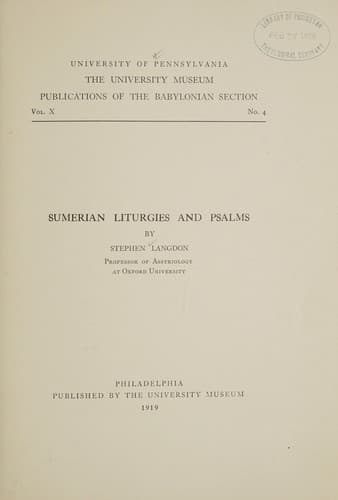
Hymns, Sumerian; Sumerian language -- Texts; Sumerians -- Religion
According to the catch line of tablet two of the Ninurta liturgy _gud-nim
kurra_ the third tablet of that series began by the same melody as tablet
three of the _elum didara_.(480) It is probable that the first melody of
tablet three of both series was identical. Melodies are always identified
by their first lines and when these agree we assume that the entire
melodies are identical. Since the musicians referred to all melodies by
their first lines it was manifestly impossible to begin two different
melodies with the same line. But tablet three of the weeping mother
liturgy _muten nu-nunuz-gim_ begins its first melody(481) _nin-ri nin-ri
gù-ám_, etc., otherwise both melodies differ completely. This is the first
known of example of two different melodies bearing the same title. It is
curious indeed that an Enlil, a Ninurta and a _mater dolorosa_ series all
begin their third tablets in the same manner.
The obverse of BM. 78239 breaks away before the end of the melody _nin-ri
ninri gú-ám-me_. Here forty-five Sumerian lines are lost; one or two
melodies at least stood in this break. For the last passage on tablet
three, the scribe borrows the first melody of the Ninurta series _gud-nim
kurra_.(482) The litanies which begin these melodies or series of
addresses to Ninurta differ greatly in the two redactions. Since SBH. No.
18 belongs to a Ninurta series the addresses therein are much more
extensive. The composer of the Enlil series _elum didara_ obviously
introduced this irrelevant melody to obtain the fine passage to the
weeping mother, Rev. 10-21 on BM. 78239. These lines are lost on the
Berlin text SBH. No. 18. On the whole the liturgy _elum didara_ is more
inconsistent in the development of ideas than any song service of which
extensive portions are known. Only tablets one and three are as yet
identified and neither of these is much more than half complete.
_ru-ba-tum (rubatum) ši-si-it âli i-šes-si ina lal-la-ra-ti_
The princess, the princess, in misery shouts the wailing of the city.(483)
‐‐‐‐‐‐‐‐‐‐‐‐‐‐‐‐‐‐‐‐‐‐‐‐‐‐‐‐‐‐‐‐‐‐‐‐‐
1. _nin-ri nin-ri gú-ám-me úru in-ga-ám-me ù-li-li_
1.
2. _a gašan-mu nu-nunuz-šág-ga ù_
2. How long my queen, the pious woman, in misery?(484)
3. _é-gí-a é-sag-il-la_(_485_)_ ù_
3. The bride of Esagila in misery?
4. _dumu-sag __d.__Uraša-a ù_
4. First born daughter of Urasha in misery?
5. _dumu-sag é-i-be- __d.__A-nu-um ù_
5. First born daughter of the temple Ibe-Anum in misery?
6. _gašan-gù-ur-a-sĭg ud-lal-a-ge ù_
6. The obedient queen, she the ..., in misery?
7. _gašan-mu __d.__Na-na-a ù_
7. My queen Nana in misery?
8. _é-zu é-zu-šú ù_
8. (How long) shall thy temple for thy temple in misery be?
9. _uru-zu uru-zu-šú ù_
9. Thy city for thy city in misery be?
10. _dam-zu dam-zu-šú ù_
10. Thy wives for thy wives in misery be?
11. _dumu-zu dumu-zu-šú ù_
11. Thy sons for thy sons in misery be?
Public-domain text, read in full here on John Shaqi.
Reviews
Reviews
No reviews yet
Be the first to share your thoughts on this work.
Elsewhere in the archive
Join the Discussion
Join the discussion
Sign in to leave a comment or review.
Sign InorCreate an account