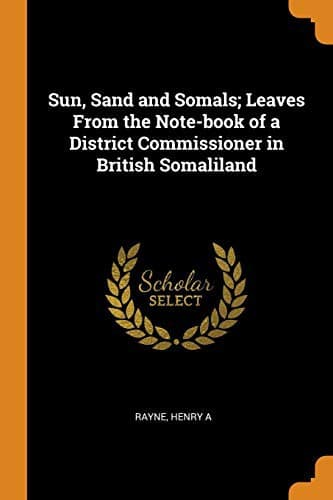
Sun, Sand and Somals: Leaves from the note-book of a District Commissioner in British SomalilandRayne, Henry A.
History
Sun, Sand and Somals: Leaves from the note-book of a District Commissioner in British Somaliland
Rayne, Henry A.
British Somaliland
"The ship beat to quarters, and orders were given to fire at the
masts of the dhows. Shots from the seven inch and the sixty-four
prs. passed repeatedly through their sails, but masts and
halyards were not struck and the dhows held on their courses,
rapidly diminishing the distance between them and the shore,
now only about two miles distant. The order was then given to
open fire with the Gardner guns in the Tops, at the dhows' poops
where the steersman sits. The effect of the showers of bullets
was instantaneous; the captain of the largest dhow was killed at
once, and, no one caring to take his place at the helm, she came
to the wind and the crew lowered her sail. An armed boat was
sent to take charge of her.
"The ship then chased No. 2 dhow, who seeing the first dhow had
given in lowered her sail and gave in also. In the meanwhile
No. 3 dhow had got far away, and an exciting chase took place,
the ship firing from all her guns at every possible chance, the
dhow doing her best to get away; but a lucky hit brought her
to, her captain, being struck while steering her by a shot from
the Gardner gun, sprang up and fell overboard; she then gave
in. While chasing this dhow, dhow No. 2 had tried to hoist her
sail and get away, but the boat's crew promptly opened fire on
her with their rifles; she then finally gave in. The crews and
owners of the slaves were then brought on board (thirty-three in
number). These men were in charge of the slaves, but the real
owners are large merchants in Jeddah, Mecca, Hodeida, and other
Turkish ports in the Red Sea. The slaves, two hundred and four
in number, were then brought on board; they were chiefly from
the district of Goojan in Abyssinia; the females especially
seemed to have been well taken care of as they fetch a high
price. The dhows were then taken in tow and the ship proceeded
to Aden.
"The greater part of the rescued slaves were Christians, amongst
whom were some very clean, tidy, and intelligent girls varying
from six to eighteen years of age. It seems monstrous that they
should be taken to satisfy the lusts of Turkish Mahomedans. They
were all well looked after on board, and seemed to recognise
that they were among friends, for they were soon laughing and
chatting; parties among them who had been separated in the dhows
were hugging and kissing each other in a very affectionate
manner. Whatever their future may be it cannot be worse than
that from which they have escaped. A great many Europeans at
Aden are offering to take care of them, and there seems every
chance of the greater part at least having happy homes."
Public-domain text, read in full here on John Shaqi.
Reviews
Reviews
No reviews yet
Be the first to share your thoughts on this work.
Elsewhere in the archive
Join the Discussion
Join the discussion
Sign in to leave a comment or review.
Sign InorCreate an account