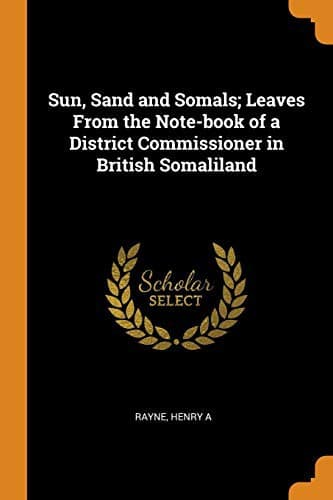
Sun, Sand and Somals: Leaves from the note-book of a District Commissioner in British SomalilandRayne, Henry A.
History
Sun, Sand and Somals: Leaves from the note-book of a District Commissioner in British Somaliland
Rayne, Henry A.
British Somaliland
On the 22nd, the bulk of the dervish troops were frustrated in an
attempt to get away their camels loaded with their worldly goods,
by the reappearance of the aeroplanes, which put in some excellent
work with the machine guns. It was then that the Mullah adopted the
policy of every man for himself, and showed the others how to do it.
His baggage camels, loaded with personal effects and two Maxim guns
captured from the British in past wars, he decided should follow
on behind, whilst he made his way South with some of his wives and
female relations, and a party of mounted fighting men. Among the
latter was a man called Ibrahim, his wife and sister.
As the party left the hills at night for the open plateau, Ibrahim
slipped off his pony, permitted his wife to pass, but as his sister
rode up, silently pressed her big toe. The lady dismounted from her
pony, allowing the cavalcade to move on.
Ibrahim, and his sister, reported to Colonel Summers that the Mullah
had gone.
The lady informed me that the Mullah had changed his mind about the
Maxim guns and had sent instructions that they were to be hidden in
a cave at Helas, where they were later discovered by Somali scouts
and handed to the O.C. King's African Rifles. It was discovered that
one of these was the identical gun captured from the regiment when
Colonel Plunkett met with disaster in 1906. Thus did Time bring
revenge, and I was proud that my old regiment, fourteen years later,
was there to receive back one of the very few guns it had lost in
action.
On the 3rd February, Captain Cross returned from Medishe, bringing
in as loot five hundred and twenty-two rifles and much native
equipment and stores. As I had flown from El-dur-Elan to Al Afwenia
I had been obliged to leave my camp equipment behind, and was
overjoyed to find, amongst the latter, several pots, two good
frying-pans and a tea kettle. There was also, amongst other things,
a sextant marked with an R.N. officer's name; part of the diary of
the German, Emil Kirsch, who, in 1916, was sent by Lij Yassu, the
fugitive ex-king of Abyssinia, to repair the Mullah's machine guns
and rifles. Swords, revolvers, double-barrelled pistols, one of
which bore the name of a well-known gunmaker in the Strand; every
make of rifle known in Europe was there for the curio-hunter to
annex. Cross reported that Medishe had been evacuated hurriedly, and
there was no doubt that the dervishes were thoroughly demoralised.
He was much impressed by the strength of the place, the excellent
buildings and the general sanitary arrangements. A dam had been
built across the stream, and an excellent garden had been laid
out. There was no doubt about it, he stated, that the Mullah was a
thoroughly capable man.
Public-domain text, read in full here on John Shaqi.
Reviews
Reviews
No reviews yet
Be the first to share your thoughts on this work.
Elsewhere in the archive
Join the Discussion
Join the discussion
Sign in to leave a comment or review.
Sign InorCreate an account