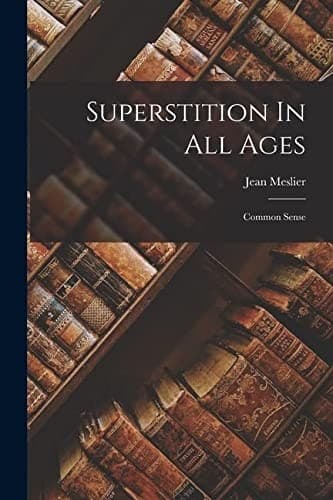
Superstition in all agesHolbach, Paul Henri Thiry, baron d'
Religion
Superstition in all ages
Holbach, Paul Henri Thiry, baron d'
Atheism
Having considered some of the silly things attributed to God by our
Christ-worshipers, let us look a little further into their mysteries.
They worship one God in three persons, or three persons in one God, and
they attribute to themselves the power of forming Gods out of dough, and
of making as many as they want. For, according to their principles, they
have only to say four words over a certain quantity of wine or over
these little images of paste, to make as many Gods of them as they
desire. What folly! With all the pretended power of their Christ, they
would not be able to make the smallest fly, and yet they claim the
ability to produce millions of Gods. One must be struck by a strange
blindness to maintain such pitiable things, and that upon such vain
foundation as the equivocal words of a fanatic. Do not these blind
theologians see that it means opening a wide door to all sorts of
idolatries, to adore these paste images under the pretext that the
priests have the power of consecrating them and changing them into Gods?
Can not the priests of the idols boast of having a similar ability?
Do they not see, also, that the same reasoning which demonstrates the
vanity of the gods or idols of wood, of stone, etc., which the Pagans
worshiped, shows exactly the same vanity of the Gods and idols of paste
or of flour which our Christ-worshipers adore? By what right do they
deride the falseness of the Pagan Gods? Is it not because they are but
the work of human hands, mute and insensible images? And what kind of
Gods are those which we preserve in boxes for fear of the mice?
What are these boasted resources of the Christ-worshipers? Their
morality? It is the same as in all religions, but their cruel dogmas
produced and taught persecution and trouble. Their miracles? But what
people has not its own, and what wise men do not disdain these fables?
Their prophecies? Have we not shown their falsity? Their morals? Are
they not often infamous? The establishment of their religion? but did
not fanaticism begin, and has not intrigue visibly sustained this
edifice? The doctrine? but is it not the height of absurdity?
End Of The Abstract By Voltaire.
PUBLISHER'S PREFACE.
By translating into both the English and German languages Le Bon Sens,
containing the Last Will and Testament of the French curate JEAN
MESLIER, Miss Anna Knoop has performed a most useful and meritorious
task, and in issuing a new edition of this work, it is but justice to
her memory [Miss Knoop died Jan. 11, 1889.] to state that her
translation has received the endorsement of our most competent critics.
In a letter dated Newburyport, Mass., Sep. 23, 1878, Mr. James Parton,
the celebrated author, commends Miss Knoop for "translating Meslier's
book so well," and says that:
Public-domain text, read in full here on John Shaqi.
Reviews
Reviews
No reviews yet
Be the first to share your thoughts on this work.
Elsewhere in the archive
Join the Discussion
Join the discussion
Sign in to leave a comment or review.
Sign InorCreate an account