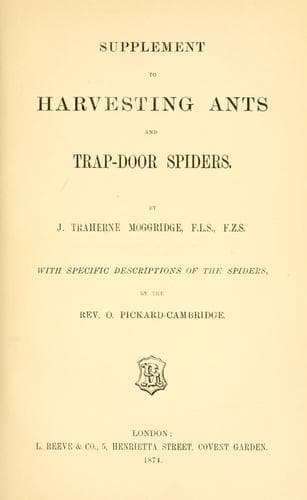
Supplement to Harvesting Ants and Trap-Door SpidersMoggridge, John Traherne
Science
Supplement to Harvesting Ants and Trap-Door Spiders
Moggridge, John Traherne
Ants; Trap-door spiders
But perhaps the most suggestive point of resemblance consists in
the habit which this Tarantula possesses of covering and closing
the aperture of the nest during the winter with a thin layer of
materials, similar to those of which the chimney is composed,
and, like them, bound together with silk. This is, in fact, an
immovable wafer-door, and precisely resembles those which I have
seen constructed by _Nemesia Manderstjernæ_, and _N. Eleanora_, when
captive and placed in an artificial hole in the earth.
The tubes are, as has been already stated, open during the spring,
and we may suppose that the spider, on the approach of warm weather,
wakes up from her winter lethargy, and tears away this concealing
thatch. But if one of these spiders should by chance happen to free
this silk-woven thatch by cutting round some three-fourths of its
circumference, so as to leave it still attached to the rim of the
aperture of the nest by the remaining quarter, she would then have
made for herself a veritable, though rather rude trap-door of the
wafer kind.
It is most likely, however, that the spider knows what she is about
and that a door to her dwelling would be the reverse of an advantage
to her, for she is more powerful and swifter than the generality of
European trap-door spiders, and, as she probably lives by leaping out
upon and hunting her prey, she no doubt needs to have the entrance to
her nest free of all encumbrance.
I am indebted to the Rev. W. G. Brackenridge for evidence of the very
interesting fact that _Lycosa narbonensis_ closes her nest at Cannes
in the winter.
I was aware that Latreille stated that the Tarantula possessed this
habit,[147] and I was anxious to know whether the species which I had
detected at Cannes, inhabiting as it did open nests in the month of
May, would also exhibit this curious custom. Being unable to visit
Cannes myself during the winter, I applied to Mr. Brackenridge,
who, on the 28th of January last (1874), secured a very perfect
specimen of the aërial portion or chimney of one of the nests having
the orifice closed in the way above described, and most kindly
transmitted it to me.
[Footnote 147: P. A. Latreille, Mem. Soc. Hist. Nat., Paris (an. VII.
de la République), p. 124: "L'araignée _tarentule_ ferme aussi son
habitation, mais cet opercule n'est pas mobile, et n'est construit
que pour l'hiver."]
I have, on a very few occasions, found the doors of a wafer or cork
nest spun up during the winter at Mentone, and on digging have
discovered the spider alive, though partially torpid, inside; but
this is quite an exceptional event. I should much like to know,
however, whether this becomes the rule in the case of the nests of
those trap-door spiders which inhabit climates less favoured than
that of Mentone.
Public-domain text, read in full here on John Shaqi.
Reviews
Reviews
No reviews yet
Be the first to share your thoughts on this work.
Elsewhere in the archive
Join the Discussion
Join the discussion
Sign in to leave a comment or review.
Sign InorCreate an account