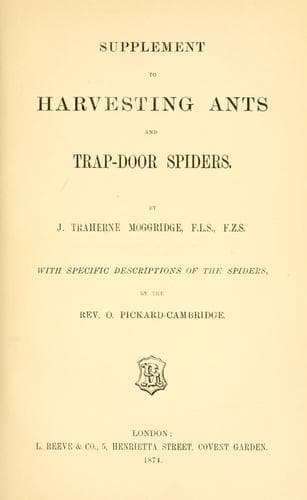
Supplement to Harvesting Ants and Trap-Door SpidersMoggridge, John Traherne
Science
Supplement to Harvesting Ants and Trap-Door Spiders
Moggridge, John Traherne
Ants; Trap-door spiders
In my concluding remarks in _Ants and Spiders_ I called attention to
the importance which attaches to a knowledge of the food and manner
of feeding of any creature whose life-history we may wish to study,
and I would now once more press the subject on the attention of my
readers. For the range and distribution of a species largely depends
upon the nature of its food, and this will also be an indication
of the rivals with which it has to compete in the struggle for
existence; the times and seasons of its activity, and in many cases
even the structure and position of its dwelling-place will be
governed by this same all-important question of food-supply.
I have now detected the remains of insects, and of ants especially,
in the nest of every species of trap-door spider which I have
examined _in situ_; very frequently, however, one may open several
nests in succession without finding any of these _débris_, and at
other times they will only be detected beneath the existing bottom of
the tube, layers of silk having been spun over successive layers of
refuse.
The horny coats of ants form by very far the largest proportion of
these remains, and I have lately been much struck by the number of
instances in which, while digging out ants' nests at Mentone, I
have found trap-door nests (especially those of _N. Manderstjernæ_
and _N. Moggridgii_) in their midst, the tubes often traversing the
very heart of the ants' colony and coming into close contact with
the galleries and chambers of the ants. The doors in these instances
had almost always escaped my notice, and, indeed, they so closely
resembled the surface of the ground that even when I knew, from
having accidentally cut across the tube below ground, that one of
these doors must lie near a given spot, yet I could only discover it
by following the passage from below upwards. This perfect concealment
is doubtless of essential importance to the spiders' success in life,
for, if they once alarmed the whole colony of ants and let them know
the exact whereabouts of their lurking-place, they would soon learn
to avoid it.
But, as it is, the work of opening the door, snatching in an ant, and
closing it again, is but the affair of a second or two, and before
the companions of the victim have time to realize the nature of the
phenomenon, the gaping earth has closed again and become once more,
to all appearance, part of the solid and trustworthy ground.
I have seen _N. Manderstjernæ_ snatch at insects in this way during
the daytime, and I well remember how I started on one occasion when,
as I was looking fixedly at a small blue gnat which I had taken for a
moth, I saw the earth suddenly open and one of these spiders partly
emerge, make a swift stroke at the insect, and withdraw again as
swiftly.
Public-domain text, read in full here on John Shaqi.
Reviews
Reviews
No reviews yet
Be the first to share your thoughts on this work.
Elsewhere in the archive
Join the Discussion
Join the discussion
Sign in to leave a comment or review.
Sign InorCreate an account