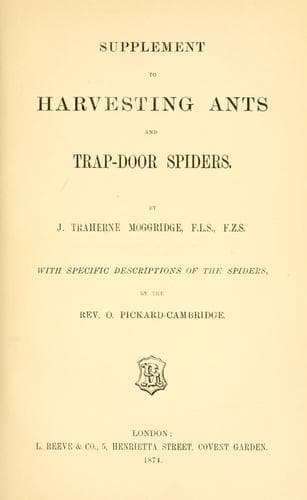
Supplement to Harvesting Ants and Trap-Door SpidersMoggridge, John Traherne
Science
Supplement to Harvesting Ants and Trap-Door Spiders
Moggridge, John Traherne
Ants; Trap-door spiders
In these two cases, as in all those previously noted, the spiders did
not leave the nest nor allow the door to close behind them, but kept
it propped up on the abdomen and hindmost pair of legs. In this way
the act of seizing their prey, and that of withdrawing into the nest,
were almost simultaneous.
In no case did we see any of these spiders out of their nests, and
their behaviour by night appeared to be the same as by day, only that
they were bolder and more on the alert.
The spiders in the cork nests (_N. Moggridgii_) resisted our attempts
to raise their doors just as rigorously as in the daytime.
All the spiders which I have kept in captivity have shown themselves
more active at night than during the day, and I imagine that
experience has taught them that fewer of their enemies are then
abroad, while ants, beetles, wood-lice, and other creatures upon
which they prey are quite as nocturnal as themselves.
I brought back to England some young cork and wafer spiders from
Hyères, and one adult cork (_N. Moggridgii_). The latter was placed
in a small tin box, with moss and a little earth at the bottom, on
the evening of May the 10th, 1873, and by next morning she had made
a silk tube through the moss, carrying up earth from below for the
purpose of strengthening its walls on the outside. On the 13th of May
the tube was furnished with a perfect door.
I hoped that this spider might lay eggs in her prison,[150] and
therefore broke up her nest from time to time after my return to
London in order to search for them. Between the 27th of May (when her
nest had been transferred into a box of earth) and the 6th of October
I destroyed her dwelling four times, and after each demolition
she furnished the cylindrical hole which I bored for her with a
lid, having thus made five doors since her capture. I got no eggs
however, though the spider appeared in perfect health.
[Footnote 150: Strange to say, though I have opened so many nests
at different seasons of the year, and found young apparently quite
recently hatched, I have never been able to find the eggs of a
trap-door spider.]
Neither this spider nor the true _N. cæmentaria_ of Montpellier
appears to have any idea of digging a hole when placed on soft earth
if they are adult; and the same thing is true of _N. Manderstjernæ_
and _N. Eleanora_, but the young of all these spiders readily
excavate nests for themselves.
I have once seen a nearly full grown, and probably adult, _Cteniza
Moggridgii_ make a perfect tube and furnish it with a moveable door
in a single night when confined under gauze on moist earth, but this
is the only instance (except that of _Cteniza Californica_, recorded
above) in which I have known an adult trap-door spider excavate or
attempt to do so.
Public-domain text, read in full here on John Shaqi.
Reviews
Reviews
No reviews yet
Be the first to share your thoughts on this work.
Elsewhere in the archive
Join the Discussion
Join the discussion
Sign in to leave a comment or review.
Sign InorCreate an account