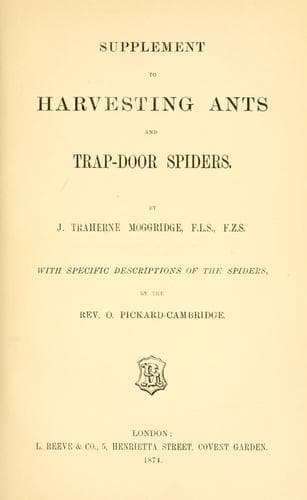
Supplement to Harvesting Ants and Trap-Door SpidersMoggridge, John Traherne
Science
Supplement to Harvesting Ants and Trap-Door Spiders
Moggridge, John Traherne
Ants; Trap-door spiders
Adult male length 5-1/2 lines, length of cephalothorax 3 lines,
breadth 2-1/2.
The cephalothorax is of a short, broad-oval form, its length being
only half a line greater than its breadth; it is flattened-convex
above, and depressed near the margins, the _caput_ (when looked
at in profile) scarcely rising above the level of the thorax.
At the junction of the caput and thoracic segments is a deep,
circularly-curved indentation, or fovea, the curve of which is
directed backwards; the extremities of this indentation are continued
obliquely forwards on either side, forming the normal ones which
indicate the junction of the caput and thorax. Rather more than
one-third of the distance between the above curved indentation and
the fore margin of the caput is a very perceptible and deep but
narrow, slightly curved, transverse indentation which divides the
caput into two distinct parts; the curve of this indentation is
directed forwards. The normal thoracic indentations are well marked,
but not very strong; the surface of the thorax, though shining,
appeared under a lens to be covered with fine rugulosities. Its
colour is yellow-brown; a large triangular patch on either side
of the caput being tinged with orange, and the rest suffused with
dark brown. The caput is of a dark reddish yellow-brown, showing
(in spirit of wine) two longitudinal bars, or strong lines, of a
clearer orange yellow-brown colour; its surface is glossy, though,
under a lens, the sides of the fore part are very finely striated or
rugulose. These lines begin behind the extremities of the hinder row
of eyes, and gradually converge to a point at the thoracic junction;
the ocular region and central longitudinal line of the fore-segment
of the caput have some long and very prominent black bristles.
When alive, the cephalothorax appears to have been suffused with a
purplish hue, corresponding to that of the abdomen and other parts.
[Illustration: _Plate XX._]
The _eyes_ form a rectangular figure, whose fore side is a little
shorter than the hinder one, and whose transverse, or longest,
diameter is as nearly as possible double the length of its shortest
one; the eyes of the central or fore-central pair are small, and
separated by a diameter's distance from each other. The hind laterals
are the smallest of the eight, and each is almost contiguous to the
hind-central nearest to it, this latter being of a sub-triangular
form, and separated from the fore-central on its side by an interval
equal to that which divides the two fore-centrals, but less than
that which separates each fore-central from the fore-lateral on its
side. Looked at as in two transverse rows of four each, those of
the foremost row are darkish coloured, while those of the hinder
row are pearly white. Omitting the eyes of the hind-central pair,
the remaining three on either side form as nearly as possible an
equilateral triangle.
Public-domain text, read in full here on John Shaqi.
Reviews
Reviews
No reviews yet
Be the first to share your thoughts on this work.
Elsewhere in the archive
Join the Discussion
Join the discussion
Sign in to leave a comment or review.
Sign InorCreate an account