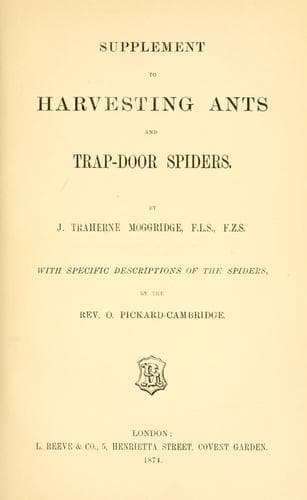
Supplement to Harvesting Ants and Trap-Door SpidersMoggridge, John Traherne
Science
Supplement to Harvesting Ants and Trap-Door Spiders
Moggridge, John Traherne
Ants; Trap-door spiders
The _maxillæ_ are strong, straight, divergent, with a small prominent
point at the inner extremity of each; they are as strong, but not so
long, as the basal (coxal) joints of the legs of the first pair, of a
yellow-brown colour, furnished with hairs, but with no spines of any
sort or size.
The _labium_ is similar in colour to the maxillæ, and somewhat
quadrate in shape, rounded at the apex; it is furnished with hairs
only.
The _sternum_ is of a sub-pentagonal form, much broader behind than
in front; its colour is dull yellowish-brown, and it is furnished
with hairs, leaving two largish, bare, round, slightly impressed
patches, not far from each other, in a transverse line near the
middle.
The _abdomen_ is short-oval in form, and very convex above; it
projects a little over the base of the cephalothorax, and its upper
side is of a purplish grey-brown hue, mottled with a pale dull
whitish-yellow, and furnished sparingly with hairs. The sides and
under side are of a uniform dull whitish-yellow. The _spinners_ (four
in number) are, as usual, of very unequal size, those of the superior
pair longish, strong, three-jointed, and up-turned, the inferior
pair short but stout, consisting of one joint only and pretty close
together.
The _female_ (as it is conjectured to be) of this species was
described, in the work to which the present publication is
supplementary, from examples found at Mentone. There is little doubt
now but that it is not _Ct. fodiens_, Walck., but whether or not
identical with the male above described is not absolutely certain.
I think myself (with Mr. Moggridge, see p. 195) that it is so, in
spite of some differences in the relative size of the eyes, the
toothing of the under side of the falces, and the denticulation
of the tarsal claws. With regard to the eyes and falces, I am not
inclined to lay special stress upon these differences. It is found
that in other groups of spiders whose cephalothorax varies very
markedly in development in the two sexes, differences of this nature
occur. In the present genus, the male has an almost flat caput,
while the female has a strongly elevated one; and with respect to
the variation in the tarsal claws, no special weight can be attached
to it in the present instance, since these claws are not uniformly
denticulated in the different feet of the same individual. Another
difference is the absence in the male of sundry small but distinct
tooth-like spines at the apex of the labium and the inner corner of
the base of the maxillæ; the female is also wanting in regard to the
very characteristic transverse indentation which divides the caput
of the male into two parts. I can, however, trace in the female the
slightest possible corresponding depression, scarcely amounting to an
indentation, and placed rather nearer to the junctional thoracic pit.
Public-domain text, read in full here on John Shaqi.
Reviews
Reviews
No reviews yet
Be the first to share your thoughts on this work.
Elsewhere in the archive
Join the Discussion
Join the discussion
Sign in to leave a comment or review.
Sign InorCreate an account