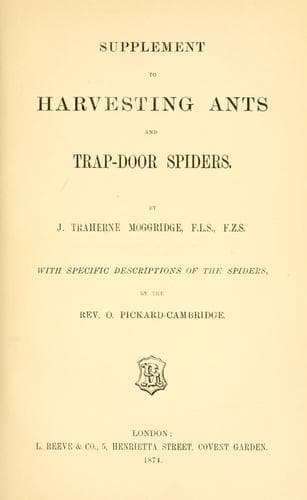
Supplement to Harvesting Ants and Trap-Door SpidersMoggridge, John Traherne
Science
Supplement to Harvesting Ants and Trap-Door Spiders
Moggridge, John Traherne
Ants; Trap-door spiders
differences I can find no distinction between them.
The male of the present species is very nearly allied to both _N.
incerta_ (p. 276) from the Pyrenees, and _N. dubia_ (p. 280) from
Digne, of both of which, as remarked (l.c.), the male sex alone
is known to me; it is, however, larger than either, more richly
coloured, and more distinctly marked. In all three species the
elongated portion of the palpal bulb has a simple point, but in
the present spider it is not drawn out so finely and gradually:
some portion of its extremity being, though very fine yet really,
cylindrical, and not tapering off into a hair-like termination; the
general direction of the palpal bulb is parallel with the radial
joint, but the point which is equally curved is directed outwards
and a little downwards; the radial joint has four spines at the
fore extremity on the upper side (in one of the examples there were
however seven on the radial joint of the right palpus), and the
genual joint of each leg of the third pair, in both examples from
Mentone as well as in M. Ausserer's example from Nice, has three
spines on its outer side. This character was not remarked upon in
the description of _N. meridionalis_ ♀ (Cambr. l.c.). It is not
invariable in a long series of female examples; occasionally one
is found with four spines on one of these genual joints, in others
there is occasionally but one spine and sometimes (but rarely)
none; perhaps in this case broken off? I am inclined to attach
some importance as a specific character to the number, presence,
or absence of these spines on the outer side of the genual joint
of the third pair of legs; not that it is an invariable character,
few, if any, specific characters are absolute and invariable, nor
that it is of more importance than the armature of other portions
of the different legs, but as being more easily observed and less
liable to injury than the larger and more numerous spines on other
parts. Equally useful in specific determination are the spines at the
fore-extremity on the upper side of the radial joint of the palpus.
This, however, applies only to the male, whereas the character
derived from the spines on the genual joints of the third pair of
legs applies to both sexes.
Another character by which the present species (♀) may be
distinguished from _N. dubia_ (_N. cæmentaria_, Sim.) is that the
former is rather narrower at the fore-extremity of the caput, which
is also less elevated, being almost equally level with the thorax.
Public-domain text, read in full here on John Shaqi.
Reviews
Reviews
No reviews yet
Be the first to share your thoughts on this work.
Elsewhere in the archive
Join the Discussion
Join the discussion
Sign in to leave a comment or review.
Sign InorCreate an account