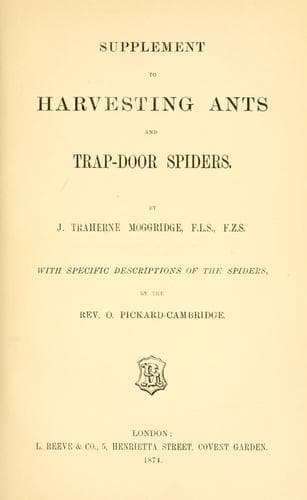
Supplement to Harvesting Ants and Trap-Door SpidersMoggridge, John Traherne
Science
Supplement to Harvesting Ants and Trap-Door Spiders
Moggridge, John Traherne
Ants; Trap-door spiders
The two species, although bearing such great general similarity to
each other, may be at once distinguished by several very tangible
differences. First in regard to the _male_. The _cephalothorax_ of
_N. meridionalis_ has the whole caput of an almost uniform dark brown
colour, two slender yellow lines beginning, one a little way behind
each lateral pair of eyes, and converging rather quickly towards each
other, run on nearly parallel, but in close proximity together to
the thoracic fovea. The centre of the thorax is also dark brown, the
brown portion formed by radiating confluent patches, rather than by
distinct lines as in _Manderstjernæ_. The curve of the thoracic fovea
is sharp, in fact more in the form of a straight line with the ends
bent down.
The _cephalothorax_ is of nearly one uniform level and convexity
above; the caput being a little more rounded than the thorax; the
eye eminence seemed to be rather higher than in _N. Manderstjernæ_,
and the _clypeus_, which is steepish, is impressed in the middle and
exceeds in height half that of the facial space; on the lower margin
of the _clypeus_ is a transverse row of several strong prominent
bristles. There were no bristles behind the eyes, and no appearance
of any having been broken off there (the female, however, has a
single longitudinal row on the caput). The lateral and hinder margins
of the cephalothorax, however, are, in the male (but not in the
female) clothed with black bristles and bristly hairs.
The _palpi_ are longer than in _Manderstjernæ_. The radial joints
have, at the upper fore extremity of each, five spines, _three_ in
front in a transverse line, and _two_ immediately behind them. The
palpal bulb is more globular, and the spiny production, which is not
very long, springs from it more suddenly, and is _strongly sinuous_,
its sharp tapering point directed outwards. The strong sinuosity of
this part distinguishes it at once both from _N. Manderstjernæ_ and
all other known European males with a simple point to the palpal
organs.
The _legs_ are longish and strong; their relative length 4-1, 3, 2
(male); 4-1, 2, 3 (female); they are furnished with hairs, bristles,
and spines. These do not appear to call for special notice, except
that each genual joint of those of the third pair has two spines on
its outer side in both sexes.
The superior tarsal claws are denticulated, but the denticulations
differ in number and strength, not only in the two sexes and in the
different legs, but in some instances in the two superior claws of
the same leg. The denticulations seemed to be more numerous in the
female than in the male.
Public-domain text, read in full here on John Shaqi.
Reviews
Reviews
No reviews yet
Be the first to share your thoughts on this work.
Elsewhere in the archive
Join the Discussion
Join the discussion
Sign in to leave a comment or review.
Sign InorCreate an account