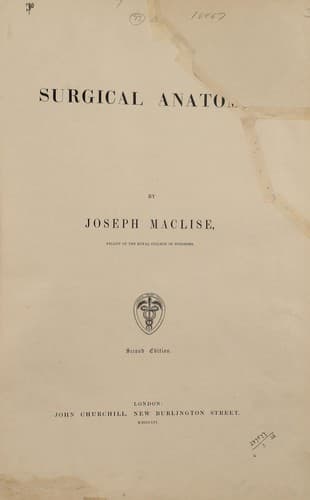
Anatomy, Surgical and topographical -- Atlases; Surgery -- Atlases; Surgery, Operative -- Atlases
When we remove the internal oblique and cremaster muscles, we expose the
transverse muscle, which may be regarded as the fifth inguinal layer, F,
Pl. 30. This muscle is similar in shape and dimensions to the internal
oblique. The connexions of both are also similar, inasmuch as they arise
from the inner edge of the crista ilii, and from the outer half of, V,
Poupart's ligament. The fleshy fibres of these two muscles vary but
little in direction, and terminate at the same place--viz., the linea
semilunaris, which marks the outer border of the rectus muscle. But
whilst the fleshy parts of these three abdominal muscles, D E F, form
successive strata in the groin, their aponeurotic tendons present the
following peculiarities of arrangement in respect to the rectus muscle.
The tendon of the external oblique, d, passes altogether in front of the
rectus; that of the internal oblique is split opposite the linea
semilunaris into two layers, which enclose the rectus between them as
they pass to be inserted into the linea alba. But midway between the
navel and pubes, at the point marked G, both layers of the tendon are
found to pass in front of the rectus. The tendon of the transverse
muscle passes behind the rectus; but opposite the point G, it joins both
layers of the internal oblique tendon, and with this passes in front of
the rectus. The fibrous structure thus constituted by the union of the
tendons of the internal oblique and transverse muscles, e f, is named
the "conjoined tendon."
The conjoined tendon, f, Plates 30 and 31, appears as a continuation of
the linea semilunaris, for this latter is in itself a result of the
union of the tendons of the abdominal muscles at the external border of
the rectus. As the conjoined tendon curves so far outwards to its
insertion into the pectineal ridge of the pubic bone, as to occupy a
situation immediately behind the external ring, it thereby fortifies
this part against the occurrence of a direct protrusion of the bowel.
But the breadth, as well as the density, of this tendon varies in
several individuals, and these will accordingly be more or less liable
to the occurrence of hernia.
The arched inferior border of the transverse muscle, F, Plate 30,
expresses by its abrupt termination that some part is wanting to it; and
this appearance, together with the fact that the fibres of this part of
the muscle blend with those of the internal oblique and cremaster, and
cannot be separated except by severing the connexion, at once suggests
the idea that the cremaster is a derivation from both these muscles.
Public-domain text, read in full here on John Shaqi.
Reviews
Reviews
No reviews yet
Be the first to share your thoughts on this work.
Elsewhere in the archive
Join the Discussion
Join the discussion
Sign in to leave a comment or review.
Sign InorCreate an account