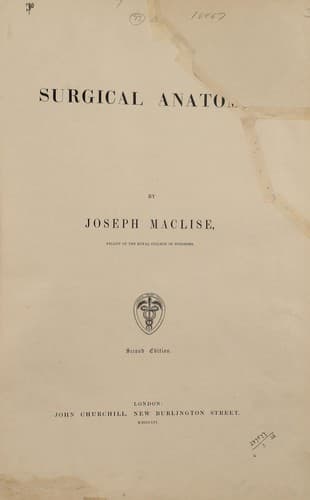
Anatomy, Surgical and topographical -- Atlases; Surgery -- Atlases; Surgery, Operative -- Atlases
As the abdomen and pelvis form one general cavity, the organs contained
in both regions are thereby intimately related. The viscera of the
abdomen completely fill this region, and transmit to the pelvic organs
all the impressions made upon them by the diaphragm and abdominal walls.
The expansion of the lungs, the descent of the diaphragm, and the
contraction of the abdominal muscles, cause the abdominal viscera to
descend and compress the pelvic organs; and at the same time the muscles
occupying the pelvic outlet, becoming relaxed or contracted, allow the
perinaeum to be protruded or sustained voluntarily according to the
requirements. Thus it is that the force originated in the muscular
parietes of the thorax and abdomen is, while opposed by the counterforce
of the perinaeal muscles, brought so to bear upon the pelvic organs as
to become the principal means whereby the contents of these are
evacuated. The abdominal muscles are, during this act, the antagonists
of the diaphragm, while the muscles which guard the pelvic outlet become
at the time the antagonists of both. As the pelvic organs appear
therefore to be little more than passive recipients of their contents,
the voluntary processes of defecation and micturition may with more
correctness be said to be performed rather for them than by them. The
relations which they bear to the abdomen and its viscera, and their
dependence upon these relations for the due performance of the processes
in which they serve, are sufficiently explained by pathological facts.
The same system of muscles comprising those of the thorax, abdomen and
perinaeum, performs consentaneously the acts of respiration, vomiting,
defecation and micturition. When the spinal cord suffers injury above
the origin of the phrenic nerve, immediate death supervenes, owing to a
cessation of the respiratory act. Considering, however, the effect of
such an injury upon the pelvic organs alone, these may be regarded as
being absolutely excluded from the pale of voluntary influence in
consequence of the paralysis of the diaphragm, the abdominal and
perinaeal muscles. The expulsory power over the bladder and rectum being
due to the opposing actions of these muscles above and below, if the
cord be injured in the neck below the origin of the phrenic nerve, the
inferior muscles becoming paralysed, the antagonism of muscular forces
is thereby interrupted, and the pelvic organs are, under such
circumstances, equally withdrawn from the sphere of volition. The
antagonism of the abdominal muscles to the diaphragm being necessary, in
order that the pelvic viscera may be acted upon, if the cord be injured
in the lower dorsal region, so as to paralyse the abdominal walls and
the perinaeal muscles, the downward pressure of the diaphragm alone
could not evacuate the pelvic organs voluntarily, for the abdominal
muscles are now incapable of deflecting the line of force backwards and
downwards through the pelvic axis; and the perinaeal muscles being also
Public-domain text, read in full here on John Shaqi.
Reviews
Reviews
No reviews yet
Be the first to share your thoughts on this work.
Elsewhere in the archive
Join the Discussion
Join the discussion
Sign in to leave a comment or review.
Sign InorCreate an account