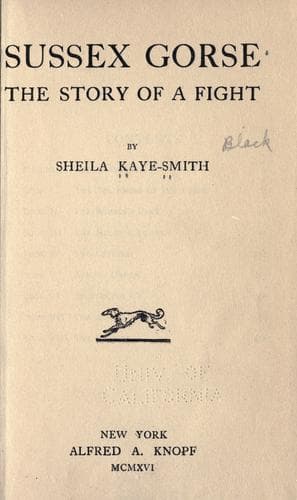
Sussex Gorse: The Story of a FightKaye-Smith, Sheila
General
Sussex Gorse: The Story of a Fight
Kaye-Smith, Sheila
Sussex (England) -- Fiction
There was nothing remarkable about the trial, and nothing to be said
against the sentence from the point of either justice or humanity. Ten
years ago the boy would have been transported to Van Diemen's Land. The
Bardons took it upon themselves to be outrageously sorry, and were
rather mystified by Reuben's contemptuous attitude towards them and
their regrets.
The evidence had been merely a repetition of that which had been given
before the magistrate, though Bessie did not cry this time in the
witness-box, and Robert in the dock was not dumb--on the contrary, he
tried to explain to the Recorder what it felt like to have absolutely no
money of one's own.
Reuben was present at the trial, and sitting erect, in his good town
clothes, drew the public glance away both from the prisoner and the
Recorder. Feeling was against him, and when in his summing-up Mr. Reeve
remarked on the strangeness of a young man of Backfield's age having no
money and being compelled to work without wages, a low murmur went round
the court, which Reuben did not seem to hear. He sat very stiffly while
the sentence was pronounced, and afterwards refused to see his son
before he was taken away to Lewes.
"Poor feller, this 'ull be the breaking of him," said Vennal outside the
Court-house.
"No more'n he deserves. He's a hard man," said Ditch.
"Thinks only of his farm and nothing of his flesh and blood," said old
Realf.
"It sarves un right," said Ginner.
So it was throughout the crowd. Some said "poor man," others muttered
"his own fault." But all words, either of pity or blame, were silenced
when Backfield came out of the Court-house and walked through the
people, his head high, his step firm, his back straight.
§ 16.
The next few weeks were for Reuben full of bitter, secret humiliation.
He might show a proud face and a straight back to the world, but his
heart was full of miserable madness. It was not so much his son's
disgrace that afflicted him as the attitude of people towards it--the
Bardons with their regrets and apologies, the small fry with their
wonder and cheap blame. What filled him with rage and disgust beyond all
else was the thought that some people imagined that Robert had disgraced
Odiam--as if a fool like Robert, with his tinpot misdoings, had it in
his power to disgrace a farm like Odiam! This idea maddened him at
times, and he went to absurd lengths to show men how little he cared.
Yet everywhere he seemed to see pity leering out of eyes, he seemed to
see lips inaudibly forming the words: "poor fellow"--"what a blow for
his schemes!"--"how about the farm?--now he'll lie low for a bit."
Public-domain text, read in full here on John Shaqi.
Reviews
Reviews
No reviews yet
Be the first to share your thoughts on this work.
Elsewhere in the archive
Join the Discussion
Join the discussion
Sign in to leave a comment or review.
Sign InorCreate an account