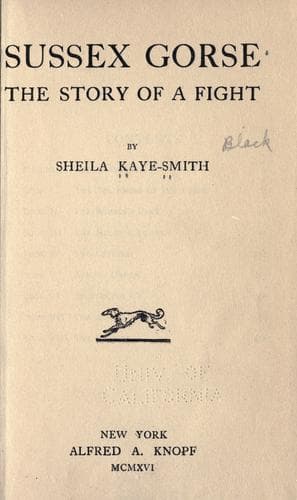
Sussex Gorse: The Story of a FightKaye-Smith, Sheila
General
Sussex Gorse: The Story of a Fight
Kaye-Smith, Sheila
Sussex (England) -- Fiction
Not that Rye elections had ever been much concerned with national
events. Borough had always been a bigger word than country on those
occasions. It was the question of the Harbour rather than the Ballot
which had sent up Captain Curteis in 1832, while later contests had
centred round the navigation of the Brede River, the new Sluice at
Scott's Float, or the Landgate clock. Reuben, however, cared little for
these petty town affairs. His chief concern was the restoration of the
tax on wheat, and he also favoured the taxing of imported malt and hops.
He hated and dreaded Gladstone's "free breakfast table," which he felt
would mean the ruin of agriculture in England. He would like to
concentrate country Toryism into an organised opposition of Free Trade,
and his wounded pride found balm in the thought of founding a local
agricultural party of which he would be the inspirer and head.
§ 17.
Reuben began to attend the Tory candidate's meetings. Colonel MacDonald
was not a local man, any more than Captain MacKinnon, but he had some
property in the neighbourhood, down on the marsh by Becket's House. Like
the other candidate, he had spent the last month or so in posting
himself in local affairs, and came to Rye prepared, as he said, "to
fight the election on herrings and sprats."
However, at his first meeting, held at Guldeford Barn, he was surprised
to find a strong agricultural element in the audience. He was questioned
on his attitude towards the wheat tax and towards the enfranchisement of
six-pound householders. The fact was that for a fortnight previously
Reuben had been working up public opinion in the Cocks, and also in the
London Trader, the Rye tavern he used on market-days. He had managed to
convince the two bars that their salvation lay in taxing wheat, malt,
and hops, and in suppressing with a heavy hand those upstarts whom
Radical sentimentalists wanted at all costs to educate and enfranchise.
Reuben could speak convincingly, and his extraordinary agricultural
success gave weight to his words. If not liked, he was admired and
envied. He was "a fellow who knew what he was doing," and could be
trusted in important matters of welfare. In a word, he achieved his
object and made himself head of an Agricultural Party, large enough to
be of importance to either candidate.
Public-domain text, read in full here on John Shaqi.
Reviews
Reviews
No reviews yet
Be the first to share your thoughts on this work.
Elsewhere in the archive
Join the Discussion
Join the discussion
Sign in to leave a comment or review.
Sign InorCreate an account