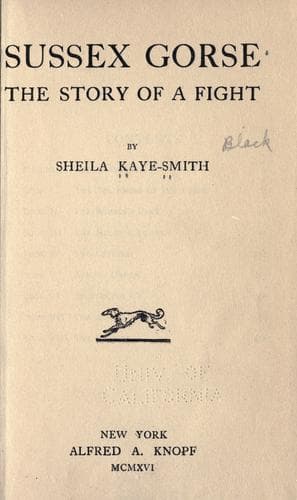
Sussex Gorse: The Story of a FightKaye-Smith, Sheila
General
Sussex Gorse: The Story of a Fight
Kaye-Smith, Sheila
Sussex (England) -- Fiction
He was too flabbergasted to be angry. The question had simply never come
into his experience. Many a man had said, "Do you think you'll do it?"
but no one had ever said, "Do you think it's worth while?"
Alice saw her blunder. She saw that she had insulted his ambition; and
yet, though she now understood the ferocities of that ambition, it
filled her with a definite hostility which made her want to fight and
fight and fight it with all the strength she had. At the same time, as
his surprise collapsed, his own antagonism rose up. He felt a sudden
hatred, not for the girl, but for the forces which somehow he knew she
was bringing to oppose him. They faced each other, their eyes bright
with challenge, their breasts heaving with a stormier, earthlier
emotion--and the white flame of antagonism which divided them seemed at
the same time to fuse them, melt them into each other.
§ 9.
Reuben was going through a new experience. For the first time in his
life he had fallen under the dominion of a personality. From his boyhood
he had been enslaved by an idea, but people, in anything except their
relation to that idea, had never influenced him. Now for the first time
he had a life outside Boarzell, an interest, a set of thoughts, which
were not only apart from Boarzell but antagonistic to it.
Hitherto he had always considered the opposite of his ambition to be the
absence of it. Either one lived to subdue the hostile earth, or one
lived with no object at all. It was a new experience to find someone
whose life was full of hopes, ideals, and ambitions, all utterly
unconnected with a farm, and it was even more strange than new that he
should care to talk about them. Not that he ever found himself being
tempted from his own--the most vital part of his relations with Alice
Jury lay in their warfare. He fought her as he fought Boarzell, though
without that sense of a waiting treachery which tinctured his battles
with the Moor; their intercourse was full of conflict, of fiery, sacred
hostilities. They travelled on different roads, and knew that they could
never walk together, yet each wanted to count the other's milestones.
Sometimes Reuben would ask himself if he was in love with her, but as
the physical element which he had always and alone called love was
absent, he came to the conclusion that he was not. If he had thought he
loved her he would have avoided her, but there was no danger in this
parliament of their minds. Her attitude towards life, though it obsessed
him, no more convinced him than his convinced her. They would rail and
wrangle together by the hour.
"Life is worth while," said Alice, "in itself, not because of what it
gives you."
"I agree with you there," said Reuben, "it's not wot life gives that's
good, it's wot you täake out of it."
Public-domain text, read in full here on John Shaqi.
Reviews
Reviews
No reviews yet
Be the first to share your thoughts on this work.
Elsewhere in the archive
Join the Discussion
Join the discussion
Sign in to leave a comment or review.
Sign InorCreate an account